Epidural Injection vs. Facet Joint Injection
Which Is Right for Your Back or Neck Pain?
An epidural steroid injection calms irritated spinal nerve roots and is typically used for radiating arm or leg pain such as sciatica. A facet joint injection targets the small joints at the back of the spine and is typically used for neck or back pain that stays in the spine and worsens with leaning back or twisting.
If you live with ongoing neck or back pain, your doctor may mention spinal injections. Two of the most common are the epidural steroid injection and the facet joint injection. They sound similar, both are done under X-ray guidance, and both are outpatient procedures. But they target different pain sources, and choosing the right one starts with understanding where your pain actually comes from.
This guide breaks down how each procedure works, the pros and cons of each, and how a pain specialist decides between them.
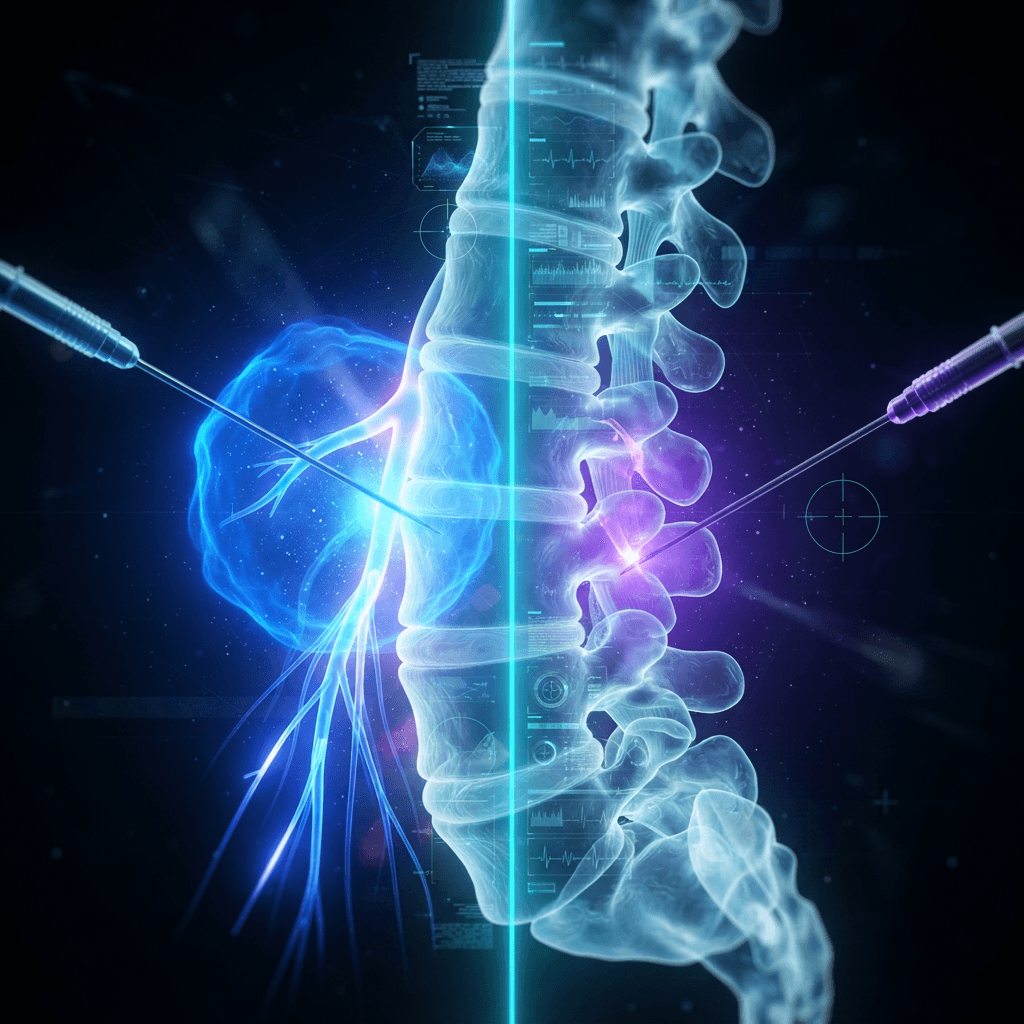
The Two Procedures at a Glance
| Epidural Steroid Injection | Facet Joint Injection | |
|---|---|---|
| What is injected | Corticosteroid, usually with a local anesthetic | Numbing medicine, often with a corticosteroid |
| Where it goes | The epidural space around the spinal nerves | Into or next to a small spinal facet joint |
| Typical pain pattern | Radiating arm or leg pain from nerve root irritation (radiculopathy, sciatica) | Axial neck or back pain, worse with extension or rotation |
| Common conditions | Disc herniation, spinal stenosis, radiculopathy | Facet joint wear, inflammation or injury |
| Guidance | Fluoroscopy (live X-ray) with contrast dye, sometimes CT | Fluoroscopy with contrast dye confirmation |
| Procedure time | About 10 to 20 minutes | A few minutes per joint; plan a few hours at the clinic |
| Anesthesia | Local numbing; sedation optional | Local numbing; IV sedation optional |
| Pain relief onset | Often 2 to 7 days; can take up to 2 weeks | Numbing medicine works in minutes; steroid takes a few days |
| Relief duration | Days to several months | Hours for the anesthetic; days to weeks or longer for the steroid |
| Typical series | 1 to 3 injections per episode, spaced weeks apart | Depends on response; several joints may be treated in one visit |
| Recovery | Home the same day; light activity in 24 to 48 hours | Home the same day; light activity in a day or two |
| Also used to diagnose? | Yes, transforaminal approach can act as a selective nerve root block | Yes, helps confirm the joint as the pain source |
Epidural Steroid Injection (ESI)
An epidural steroid injection places a corticosteroid, often with a local anesthetic, into the epidural space, the fat-filled area outside the membrane covering the spinal cord and nerves. The goal is to reduce inflammation around irritated or compressed nerves.
It does not cure the underlying condition, but it can calm inflammation enough for rehabilitation to progress. It can be performed in the neck (cervical), mid-back (thoracic) or low back (lumbar), depending on where your symptoms originate.

Three Approaches
Your physician chooses the approach based on where the irritated nerve is, your imaging, and your anatomy.
Interlaminar
Between two vertebral arches; medication spreads across a wider area. Often used for central or multi-level disc herniation, stenosis, or symptoms on both sides.
Transforaminal
Through the opening where a nerve root exits the spine; the most targeted approach, used for one-sided radiculopathy.
Caudal
Through the sacral hiatus at the base of the spine; a gentler entry point, often chosen for post-surgical pain or multi-level lumbar problems.
Epidural Pros
- Targets the cause of radiating nerve pain: inflamed spinal nerve roots
- Short outpatient procedure, about 10 to 20 minutes, with same-day discharge
- Multiple approaches let your physician tailor treatment to your anatomy
- Can create a window of relief that makes physical therapy and exercise easier
- Transforaminal injections can also confirm which nerve is causing the pain
- Minimally invasive, with local numbing and optional sedation
Epidural Cons
- Does not cure the underlying problem (such as a disc herniation or stenosis)
- Relief is variable, from days to several months, and can take up to 2 weeks to begin
- May require a series of 1 to 3 injections
- Less suited to pain that stays in the spine without radiating into an arm or leg
- Steroid-related effects are possible, such as temporary flushing or a rise in blood sugar in people with diabetes
- Rare risks include infection, bleeding, nerve irritation and headache from a dural puncture
Facet Joint Injection
Facet joints are paired joints at the back of the spine that connect one vertebra to the next. They let the spine bend and twist while staying stable. Wear, inflammation or injury can make them painful in the neck, mid-back or low back. A facet joint injection places numbing medicine, often with a corticosteroid, into or next to the joint under X-ray guidance.
Two Jobs: Diagnosis and Treatment
Diagnosis: if numbing medicine quickly reduces your usual pain, the joint is likely a pain source. Imaging alone cannot prove that a facet joint hurts, which is why a diagnostic block is used.
Treatment: a steroid mixed with the numbing medicine can calm inflammation in the joint. It takes a few days to work and does not help everyone.
A Related Option: Medial Branch Block and Radiofrequency Ablation
A medial branch block numbs the small nerves beside the joint and is the preferred test of whether the joint is the pain source. Clear relief can lead to radiofrequency ablation (RFA), which uses heat to disable those nerves for longer relief. Published studies report about 43 to 87 percent success at one year in carefully selected patients, and results depend heavily on selection.
Facet Injection Pros
- Does double duty: helps confirm the pain source and may relieve pain
- Very quick procedure, a few minutes per joint, with same-day discharge
- Numbing medicine can reduce pain within minutes, giving fast information
- Several joints can be treated in a single visit
- A positive medial branch block can open the door to longer-lasting RFA
- Image-guided facet injections are generally considered safe when done by trained physicians
Facet Injection Cons
- The 2026 ASIPP guideline gives direct intra-articular injections weaker evidence ratings, especially in the low back
- Steroid relief can be short, and some people get little lasting relief
- Pain can briefly return after the numbing medicine wears off, before the steroid builds
- Does not reverse arthritis in the joints
- Repeated steroid doses carry more steroid-related effects
- Not helpful for pain that travels below the knee or comes from a nerve root
Head-to-Head: How a Specialist Decides
Neither procedure is better in general. The right one depends on your symptoms, your physical exam and your imaging. Here are the questions your physician will weigh.

| Question | Points toward an epidural | Points toward a facet injection |
|---|---|---|
| Where is the pain? | Radiates into an arm or leg; may include numbness or tingling | Stays in the neck or back; may spread to shoulders, buttock or thigh |
| What makes it worse? | Nerve-related positions or activities; sitting or standing patterns that irritate the nerve | Leaning back, twisting, turning the head or looking up; stiffness after rest |
| What does imaging show? | Disc herniation, stenosis, foraminal narrowing | Joint wear, though imaging alone cannot prove the joint hurts |
| What is the goal? | Reduce nerve inflammation | Treat the joint and confirm it as the pain source |
| What may come next? | Repeat injection or rehabilitation program | Medial branch block, then possibly radiofrequency ablation |
Good to Know
Insurers commonly do not cover several different spinal injections in the same session, so your physician will usually plan one procedure at a time.
Who should talk carefully with a physician first?
For either procedure, discuss the following before scheduling: an active infection, a bleeding disorder or uncontrolled bleeding risk, an allergy to the medicines used, pregnancy, and all medications including blood thinners. Never stop a blood thinner on your own; your prescribing physician and the treating team decide together.
When to Seek Urgent Medical Care
Call right away or seek urgent care for any of the following:
Pain that travels below the knee or comes with leg weakness, numbness, or bladder or bowel changes needs urgent review because it may have another cause.
Frequently Asked Questions
Is a facet injection better than an epidural?
Neither is better in general. Facet injections target joint pain in the neck or back, while epidural steroid injections target irritated nerve roots that cause arm or leg pain.
Do these injections cure my condition?
No. Both reduce pain and inflammation but do not reverse the underlying problem. They are most useful as part of a broader plan that includes exercise and physical therapy.
Will it hurt?
Most people feel pressure and a brief sting when the skin is numbed, then little pain during the injection. Soreness at the site for a day or two is common.
How long until I feel relief?
Facet injections: numbing medicine works within minutes and the steroid takes a few days. Epidurals: often 2 to 7 days, sometimes up to 2 weeks.
Can I have both?
Some patients have pain from more than one source. Your physician will usually plan one procedure at a time based on your exam, imaging and response.
Let Our Specialists Review Your Case
Our board-certified pain management specialists will review your symptoms, imaging and history to determine whether an epidural steroid injection, facet joint injection or medial branch block is right for you.
9701 66th Ave, Rego Park, NY 11374
Mon, Tue, Thu, Fri 9:00 am - 6:00 pm | Sun 9:00 am - 3:00 pm | Closed Wed and Sat
Medical disclaimer: This article is for general educational purposes only and does not constitute medical advice. Spinal injections are medical procedures that require individual evaluation by a licensed physician. Individual results vary, and Queens Pain Clinic does not guarantee any specific outcome. Always consult a qualified healthcare provider before making treatment decisions.