Radiofrequency Ablation for Neck and Back Pain in Queens, NY
An outpatient, same-day procedure for pain that a diagnostic block traces to the small nerves beside your spinal joints.
Radiofrequency ablation (RFA) is offered by our board-certified physicians in Rego Park when a diagnostic block identifies the small nerves beside your spinal joints as the source of your pain. A thin needle is placed next to the nerve under live X-ray and heated to disable it.
Relief usually begins within 1 to 3 weeks and often lasts 6 to 12 months or longer. It varies, and RFA does not suit every kind of back or neck pain. Your physician will tell you honestly whether it fits.
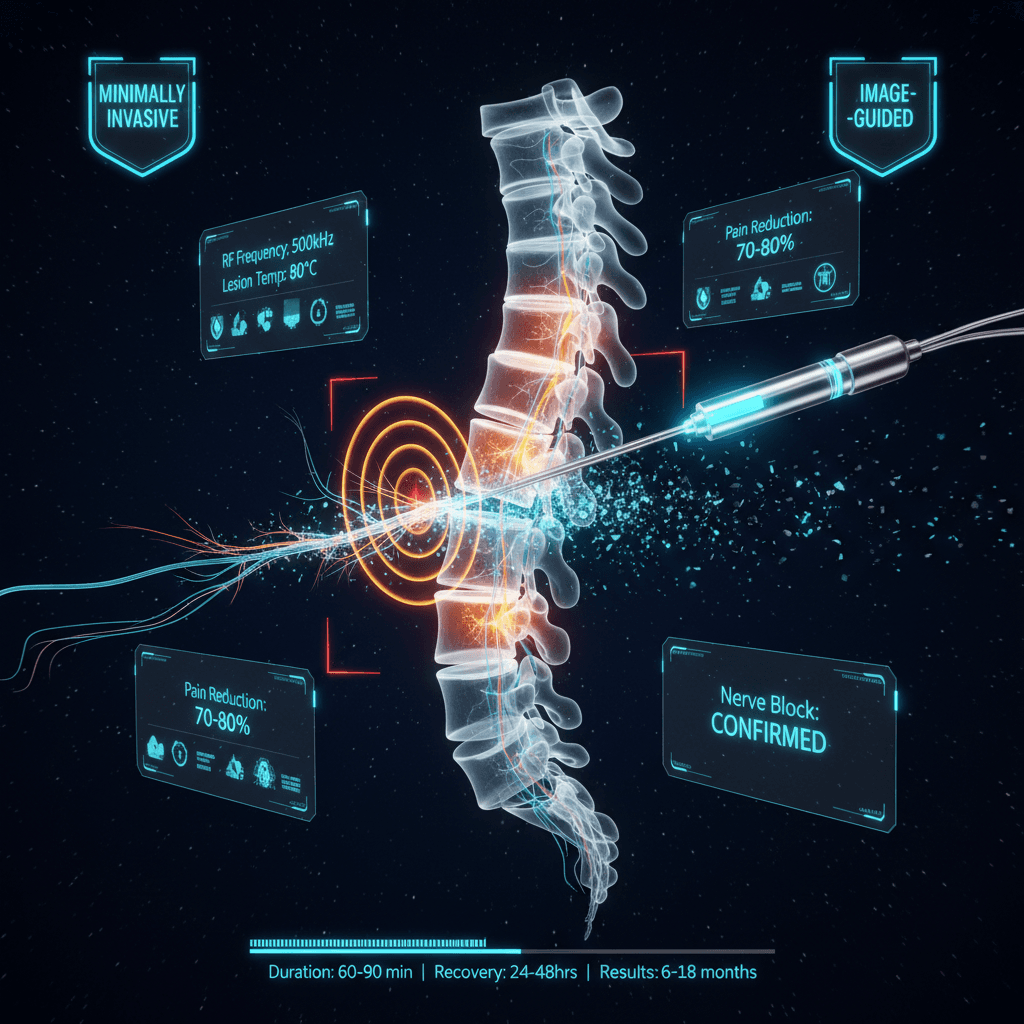
Radiofrequency ablation (RFA) is an outpatient, same-day procedure offered by board-certified physicians in Rego Park. When a diagnostic block shows that the small nerves beside your spinal joints are the source of your pain, we place a thin needle next to the nerve under live X-ray and use radiofrequency heat to disable it. The nerve eventually regrows, so the treatment can be repeated. Relief often lasts 6 to 12 months or longer, but it varies from person to person.
Key Features
Conditions Addressed
Top Benefits
Radiofrequency heat used to disable the medial branch nerve that carries pain from a facet joint
About 60 to 90 minutes, depending on the number of nerves treated
Local numbing, with optional light sedation
None. You go home the same day
Usually within 1 to 3 weeks
Often 6 to 12 months or longer, and it varies
Possible when the nerve regrows and pain returns
1-877-97 NO PAIN
How Does Radiofrequency Ablation Work?
Each facet joint in your spine has a tiny nerve, called the medial branch nerve, that carries pain from the joint to the brain. When a joint is irritated or worn, that nerve keeps sending pain signals.
RFA uses radiofrequency heat to disable that nerve. A thin needle is placed beside it under live X-ray (fluoroscopy) and heated to about 80°C for 60 to 90 seconds. The nerve eventually regrows, so the effect is not permanent, and the treatment can be repeated.
Before RFA, we usually do a medial branch block. It temporarily numbs the suspected nerve so you can track your pain over several hours.
At least 50 percent relief (some physicians use 80 percent) supports that nerve as the pain source and your candidacy for ablation. If the block does not help, we look for another source of pain.
Steroid injections calm inflammation. RFA interrupts the pain signal coming from a joint. They are different tools for different problems, and many patients use both at different times.
Who Is a Good Candidate for RFA?
RFA is for joint pain that a diagnostic block has confirmed. It is not the right tool for every kind of back or neck pain.
- Neck, mid-back or low-back pain that is not radiating down an arm or leg
- Pain that worsens with twisting, leaning backward or prolonged standing
- Pain that has lasted around three months or more despite conservative care
- A clear improvement, even a brief one, after a diagnostic medial branch block
- Pain from a pinched nerve root
- An active infection
- A bleeding disorder
- Blood thinners that cannot be paused
Tell us if you are pregnant or have a pacemaker or other implanted device. If RFA isn't appropriate, we will discuss alternatives with you.
What RFA Is Used to Treat
These are the conditions we evaluate for RFA when diagnostic blocks confirm the source. Bulging-disc or pinched-nerve-root pain generally needs another plan.
Lumbar facet arthritis (lumbar spondylosis)
The most common indication, when diagnostic blocks confirm the facet joints as the source.
Cervical facet pain (cervical spondylosis)
Includes neck pain that began after whiplash, when diagnostic blocks confirm the source.
Mid-back facet pain
Pain from the facet joints of the thoracic spine, confirmed with diagnostic blocks.
Sacroiliac joint pain
Considered after a diagnostic sacroiliac joint injection points to the joint as the source.
Ongoing spinal pain after surgery
When facet or sacroiliac joint pain remains after an operation and blocks confirm it.
What Happens During RFA
Five steps, from check-in to going home the same day.
Check-in and positioning
You check in and lie face down on the procedure table. Your physician confirms the plan and the nerves to be treated.
Numbing
The skin is cleaned and numbed with local anesthetic. Light sedation is available if you want it.
Needle placement
Using live X-ray (fluoroscopy), the physician guides a thin needle next to the medial branch nerve.
Electrical testing
A mild electrical test confirms the target and helps avoid motor nerves. You may feel tingling or a brief muscle twitch.
Heating and discharge
The needle tip is heated to about 80°C for 60 to 90 seconds at each site. After a short rest you go home the same day. If you had sedation, arrange for a driver.
Recovery, Risks and How Long Relief Lasts
Needle-site soreness can last a few days and sometimes up to two weeks. You may notice a temporary sunburn-like sensation or a temporary flare of your usual pain. Ice and suitable over-the-counter pain relievers may help.
Light activity often resumes in 1 to 2 days. Your physician will advise you on heavier lifting and exercise.
Relief builds over 1 to 3 weeks. Many people get six months to a year, some get longer, and some get little benefit. RFA does not reverse joint wear.
We encourage physical therapy during the relief window. If the first treatment worked well, repeating it after the nerve regrows is a reasonable option and often has similar results.
Soreness, numbness or tingling, and a short-lived increase in pain.
Bruising, or skin sensitivity that lasts for weeks.
Infection, bleeding or a skin burn are uncommon. Lasting nerve injury is rare. Your physician will review your individual risks and medical history before you consent.
RFA Compared with Steroid Injections
| Feature | Steroid injection | Radiofrequency ablation |
|---|---|---|
| What it does | Calms inflammation around an irritated nerve | Interrupts pain signaling from a facet joint |
| Typical relief | Days to a few months | 6 to 12 months or longer |
| Best suited to | Flare-ups, inflamed nerve roots, or arm and leg symptoms | Joint pain confirmed by diagnostic blocks |
| Repeat use | Frequent repetition is discouraged because of steroid exposure | Reasonable after the nerve regrows if the first treatment worked well |
These are not rivals. Some patients move to RFA when injection relief wears off. Read more about our epidural injections, facet joint injections and sacroiliac joint injections.
Many plans, including Medicare, may cover RFA when their criteria are met. That commonly means documented relief from diagnostic blocks, often two. Requirements and out-of-pocket costs vary.
Our team checks your benefits and obtains prior authorization before we schedule. See our insurance and payment options pages.
Queens Pain Clinic has treated chronic pain in Queens since 2004. We serve Rego Park and nearby Forest Hills, Elmhurst and Kew Gardens. Your first step is a consultation: we review your history and imaging, examine you, and decide together whether a diagnostic block makes sense.
Phone: 1-877-97 NO PAIN
These pages may also help.
Radiofrequency Ablation FAQs
Ready to Find Out If RFA Fits?
If neck or back pain has lasted months despite conservative care, come in for a consultation. We will review your history and imaging, examine you, and tell you plainly whether a diagnostic block and radiofrequency ablation make sense, or whether another approach would serve you better.
9701 66th Ave, Rego Park, NY 11374
Phone: 1-877-97 NO PAIN
Treating chronic pain in Queens since 2004.
- Monday9:00 am to 6:00 pm
- Tuesday9:00 am to 6:00 pm
- WednesdayClosed
- Thursday9:00 am to 6:00 pm
- Friday9:00 am to 6:00 pm
- SaturdayClosed
- Sunday9:00 am to 3:00 pm
This page is for general information and is not medical advice. Results vary from person to person. Talk with a qualified clinician before starting a new treatment.