Facet Joint Injection
A facet joint injection places numbing medicine, often with a corticosteroid, into or next to a small spinal joint to relieve neck, mid-back or low back pain and to confirm that the joint is the source. It is X-ray guided and takes a few minutes per joint.
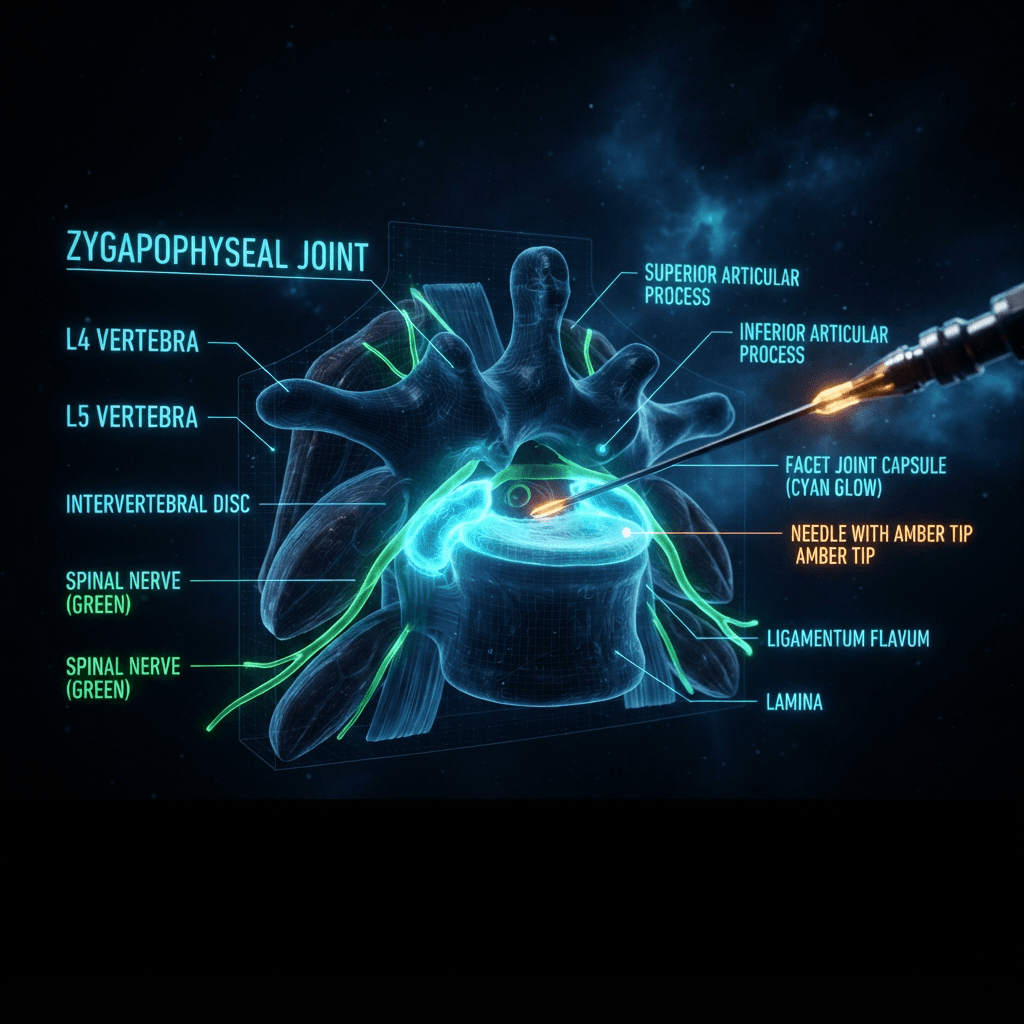
A facet joint injection is an image-guided procedure that places numbing medicine, often with a corticosteroid, into or next to a small spinal joint to relieve neck, mid-back, or low back pain and to confirm that the joint is the source of that pain. It is performed in a procedure room using X-ray guidance and usually takes a few minutes per joint.
Key Facts at a Glance
- Facet joints are paired joints at the back of the spine that connect one vertebra to the next.
- Used for both diagnosis (confirming the pain source) and treatment (reducing inflammation).
- Performed as an outpatient procedure — most patients go home the same day.
- A positive medial branch block can qualify a patient for radiofrequency ablation.
How Does a Facet Joint Injection Work?
Facet joints are paired joints at the back of the spine that connect one vertebra to the next. They let the spine bend and twist while keeping it stable. Wear, inflammation, or injury can make these joints painful, and the pain can arise in the neck, the middle back, or the low back.
Two Jobs: Diagnosis and Treatment
Diagnosis: If numbing medicine quickly reduces your usual pain, the joint is likely a pain source. This is why facet injections and medial branch blocks are used to decide whether further treatment is worthwhile.
Treatment: A steroid mixed with the numbing medicine can calm inflammation in the joint. Steroids take a few days to work, and they do not help everyone.
2026 ASIPP Evidence Ratings
- Diagnostic facet nerve blocks (low back): moderate to strong evidence
- Diagnostic facet nerve blocks (neck and mid-back): moderate evidence
- Therapeutic medial branch nerve blocks: moderate evidence with moderate strength of recommendation
- Direct intra-articular injections: weaker ratings, especially in the low back
Typical Facet-Related Symptoms
- Neck ache that spreads across the neck and shoulders, worse with turning the head or looking up
- Low back pain that worsens with leaning back or twisting and may spread into the buttock or thigh
- Stiffness after rest
- Tenderness over the joints
Important Warning
Pain that travels below the knee, or comes with leg weakness, numbness, or bladder or bowel changes, needs urgent medical review because it may have another cause. Imaging alone cannot prove that a facet joint hurts, which is why a diagnostic block is used.
Quick Facts
| Question | Short Answer |
|---|---|
| What is injected? | Numbing medicine (local anesthetic), often with a corticosteroid |
| Target location | Into or next to a small spinal facet joint |
| Guidance | X-ray (fluoroscopy) with contrast dye confirmation |
| Duration of procedure | A few minutes per joint; plan a few hours at the clinic |
| Anesthesia | Local numbing; IV sedation optional |
| Volume injected | Often about 1 mL per joint; several joints may be treated in one visit |
| Recovery | Same-day discharge; light activity within a day or two |
| Pain relief onset | Numbing medicine works within minutes; steroid takes a few days to build |
| Relief duration | Varies — hours for the anesthetic; days to weeks or longer for the steroid |
| Best for | Axial neck or back pain worsened by extension or rotation |
Types of Facet Joint Procedures
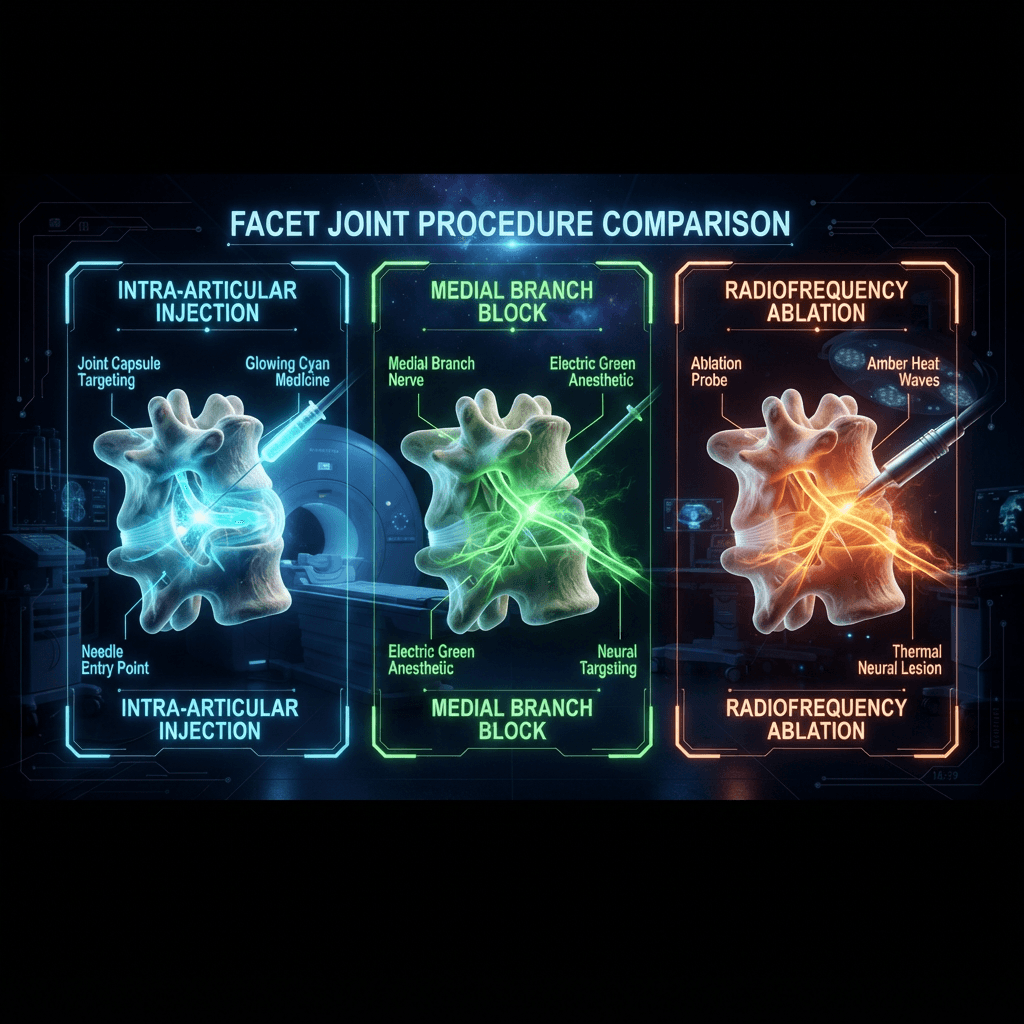
Facet joint procedures range from direct intra-articular injections to medial branch blocks and radiofrequency ablation. Your physician selects the approach based on your pain pattern, imaging findings, and whether a diagnostic block is needed to confirm the pain source before pursuing longer-term treatment.
A medial branch block numbs the small nerves beside the joint and is the preferred test of whether the joint is the pain source. Clear relief may lead to radiofrequency ablation, which uses heat to disable those nerves for longer relief.
| Procedure | Target | Main Purpose | 2026 ASIPP Evidence for Treatment |
|---|---|---|---|
| Facet Joint Injection | Inside the joint | Treatment, sometimes diagnosis | Weaker ASIPP 2026 rating, especially low back |
| Medial Branch Block | Nerves beside the joint | Diagnosis and treatment | Moderate ASIPP 2026 rating; preferred diagnostic test |
| Radiofrequency Ablation (RFA) | Same nerves, heat applied | Longer-term treatment | Moderate in systematic reviews; considered after positive blocks |
Spinal Regions Treated
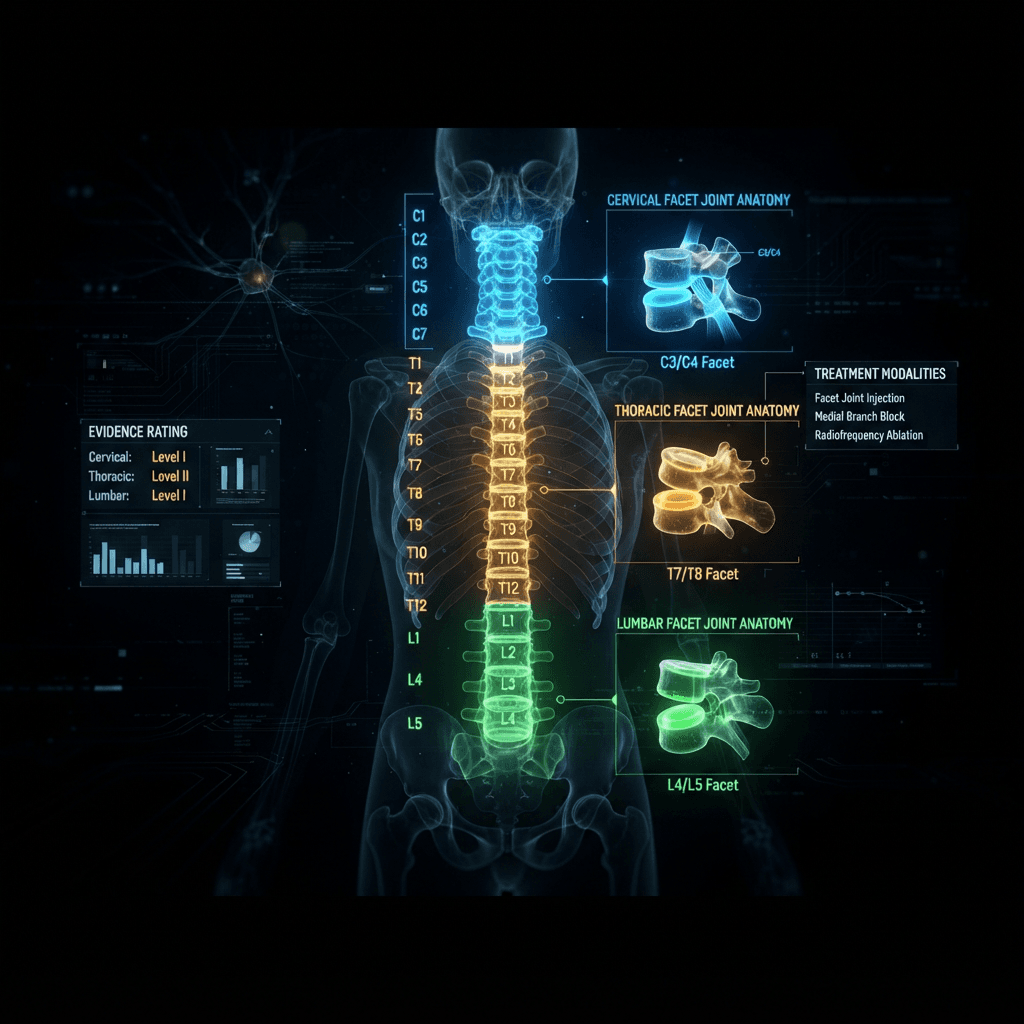
Facet injections may be performed in the cervical, thoracic, or lumbar regions. The low back has the strongest research base, cervical therapeutic nerve blocks have a moderate recommendation, and thoracic diagnostic-block evidence is moderate.
Cervical (Neck)
Pain across the neck and shoulders, worse turning or looking up; related headaches can occur
2026 ASIPP guideline gives therapeutic cervical nerve blocks a moderate recommendation
Thoracic (Mid-Back)
Mid-back pain; less common than cervical or lumbar
Diagnostic block evidence rated moderate by ASIPP 2026
Lumbar (Low Back)
Low back pain worsening with leaning back or twisting; may spread to the buttock or thigh
Most studied region; moderate to strong diagnostic evidence for nerve blocks (ASIPP 2026)
Who Is a Candidate?
A physician reviews your examination and imaging to choose an intervention. You may be a candidate if you have:
Candidacy Checklist
Neck or back pain that has lasted for weeks to months
Pain worsens with extension or rotation (looking up, turning the head, leaning back)
Pain has not improved enough with exercise, medicine, or physical therapy
A physician has examined you and reviewed your imaging
Discuss Carefully With Your Physician First
| Situation | Why |
|---|---|
| Active infection | Needle procedures can spread infection |
| Bleeding disorder or uncontrolled bleeding risk | Higher risk of bleeding at the injection site |
| Allergy to the medicines used | Risk of allergic reaction |
| Pregnancy | Discuss carefully with your physician |
How to Prepare
Disclose all medications
Tell the team about blood thinners, allergies, diabetes, pregnancy, and any infection.
Blood thinners
Do not stop any blood thinner on your own. The 2026 ASIPP guideline supports continuing antithrombotic therapy in many cases, but your prescribing physician and the treating team decide together.
Fasting
Fasting rules depend on whether you receive sedation. Follow clinic instructions. If you have diabetes, ask how to manage medicines and meals on the day.
Arrange a ride
Arrange a ride home if you will receive sedation.
What Happens During the Procedure?
A facet joint injection takes a few minutes. After the skin is cleaned and numbed, the physician guides a thin needle to the painful joint with X-ray imaging and injects numbing medicine, often with a steroid.
Before
Review of medicines including blood thinners, allergies, and diabetes. Fasting only if sedation is planned.
Positioning
You lie face down or on your side on the procedure table.
Imaging and skin numbing
The skin is cleaned and numbed with local anesthetic. X-ray imaging is set up.
Needle placement
The physician guides a thin needle to the painful joint using X-ray imaging. Contrast dye confirms correct position.
Injection
A small volume — often about 1 mL — is injected into each joint. Several joints may be treated in one visit.
After
You are observed briefly and usually go home within a few hours.
Recovery Timeline
Most people go home the same day, may feel numbness for a few hours, and can often return to daily routines within a day or two. Steroid effects build over several days.
Hours 0–6
Numbness or heaviness in the neck, back, or limb is possible. Rest and avoid driving until it resolves.
Days 1–2
Injection-site soreness is common. Ice may help. Many programs advise avoiding baths for the first 24 hours.
Days 2–7
The steroid begins to work. Pain may return briefly after the numbing medicine wears off before it improves.
Next steps
Keep a pain diary of your relief percentage and duration. Pair the injection with exercise and physical therapy.
Call Immediately or Seek Urgent Care For:
Fever
Spreading redness or swelling at the injection site
Severe or worsening headache
New weakness or numbness that does not fade
Loss of bladder or bowel control
Shortness of breath after a neck injection
Risks and Side Effects
Facet joint injections are generally considered safe when performed under image guidance. Soreness at the injection site is the most common effect; serious complications are rare.
Evidence on safety: A 2025 European multispecialty Delphi consensus concluded image-guided facet injections are safe regardless of imaging method used. A 2026 multisociety consensus found about 10 mg of methylprednisolone or triamcinolone per facet joint is a reasonable steroid dose.
| Risk | What to Know |
|---|---|
| Soreness or bruising | Common; usually settles in a few days |
| Temporary numbness or weakness | Local anesthetic can spread briefly |
| Steroid effects | Flushing, temporary rise in blood sugar in people with diabetes, fluid retention, menstrual changes; more likely with repeated steroid doses |
| Infection or bleeding | Rare |
| Nerve irritation or injury | Rare |
| Dural puncture and headache | Rare |
| Allergic reaction | Rare |
| No relief | Possible; itself useful diagnostic information |
Facet Injection vs. Epidural vs. Medial Branch Block
A facet injection targets pain from the small back-of-spine joints, while an epidural steroid injection targets irritated spinal nerve roots that cause leg or arm pain. The right choice depends on where the pain comes from.
| Facet Injection | Epidural Steroid Injection | Medial Branch Block | |
|---|---|---|---|
| Pain pattern | Axial neck or back pain, worse with extension or rotation | Radiating arm or leg pain from nerve root irritation | Same as facet injection |
| Needle target | Joint | Space around spinal nerves | Small nerves beside the joint |
| Typical goal | Treat and confirm source | Reduce nerve inflammation | Confirm source, guide ablation |
Note
Insurers commonly do not cover several different spinal injections in the same session, so your physician will plan one at a time.
RFA Outcomes After Positive Blocks
43–87%
Success rate at one year in carefully selected patients
~50%
Meaningful pain and function benefit at six months (single-block trial, ≥75% relief threshold)
~10 months
Average relief duration with repeat treatment in one series
Results depend heavily on careful patient selection.
Benefits of Facet Joint Injection
Facet joint injections both treat and diagnose, helping relieve joint-related spine pain and showing whether longer-lasting procedures are likely to help.
Facet joint injections are a precise, low-risk way to treat and pinpoint spinal joint pain. Results depend heavily on careful patient selection.
- Useful for both diagnosis and short-term relief
- Relief duration varies from person to person
- A good response can support longer-lasting treatment
- Best paired with exercise and physical therapy
Frequently Asked Questions
What is a facet joint injection?
A facet joint injection is an image-guided procedure that places numbing medicine, often with a steroid, into or beside a painful spinal joint. It relieves neck or back pain and helps confirm the joint as the pain source.
Does a facet joint injection hurt?
Most people feel pressure and a brief sting when the skin is numbed, then little pain during the injection itself. Soreness at the site for a day or two is common. Your team can discuss sedation options beforehand.
How long does a facet joint injection take?
The injection itself takes a few minutes. Plan on a few hours at the clinic for check-in, preparation, and a short observation period afterward — longer if several joints are treated or sedation is used.
How long does relief from a facet joint injection last?
Relief varies. The numbing medicine works for hours, and a steroid may add days to weeks or longer of benefit in some people. Others get little lasting relief. Your physician will track your response to plan next steps.
How soon does a facet injection start working?
Numbing medicine can reduce pain within minutes. Steroid effects usually take a few days to build, and pain can briefly return in between. Keep a pain diary so your physician can judge the result accurately.
Are facet joint injections safe?
When performed under image guidance by trained physicians, they are generally considered safe. Common effects are temporary soreness and bruising. Infection, bleeding, nerve injury, and allergic reaction are rare. A 2025 European consensus concluded image-guided facet injections are safe.
What are the side effects of a facet joint injection?
Common effects are injection-site soreness, temporary numbness, and with steroids: flushing, higher blood sugar in people with diabetes, or fluid retention. Serious effects such as infection or nerve injury are rare. Call right away for fever, spreading redness, or new weakness.
Who should not have a facet joint injection?
People with an active infection, a bleeding disorder or uncontrolled bleeding risk, an allergy to the medicines, or who are pregnant should discuss it carefully with a physician first. Your physician reviews your medicines, including blood thinners, before deciding.
Can I eat before a facet joint injection?
Fasting rules depend on whether you receive sedation. Follow the instructions your clinic gives you. If you have diabetes, ask how to manage your medicines and meals on the day.
Should I stop my blood thinners before a facet injection?
Do not stop any blood thinner on your own. The 2026 ASIPP guideline says antithrombotic therapy may be continued for facet interventions in many cases, but your prescribing physician and our team decide together for you.
Can I drive after a facet joint injection?
If you receive sedation, or have numbness or weakness in a limb, do not drive and arrange a ride. If you had only a local anesthetic and feel normal, your physician may allow driving. Follow your clinic's instructions.
When can I return to work and exercise?
Many people resume light activity and desk work the next day. Avoid strenuous exercise or heavy lifting for a day or two, or as your physician advises. Gentle movement and physical therapy usually help the results last.
What is the difference between a facet joint injection and a medial branch block?
A facet joint injection places medicine inside the joint. A medial branch block numbs the small nerves beside the joint that carry its pain signals. Blocks are the usual way to confirm a joint as the pain source and to qualify for radiofrequency ablation.
How many facet joint injections can I have?
The number depends on your response and your physician's judgement. A 2026 multisociety consensus addresses steroid dose, spacing, and criteria for repeating injections. Repeated steroid exposure carries more steroid-related effects, so your physician balances benefit and risk.
What is radiofrequency ablation for facet pain?
Radiofrequency ablation uses heat from a needle to disable the small nerves that carry pain from a facet joint. It is considered after blocks give clear relief. Studies report about 43 to 87 percent success at one year in carefully selected patients.
Is a facet injection better than an epidural?
Neither is better in general. Facet injections target joint pain in the neck or back, while epidural steroid injections target irritated nerve roots that cause arm or leg pain. The right one depends on your symptoms and exam.
Do facet joint injections cure arthritis?
No. They reduce pain and inflammation but do not reverse arthritis in the joints. They are used to make movement and rehabilitation easier as part of a broader plan.
Will insurance cover a facet joint injection?
Many insurers cover facet injections or medial branch blocks when criteria are met, such as pain lasting a minimum period and failed conservative care. Policies often require documented relief to approve a repeat procedure.
Can facet pain cause headaches?
Yes. Cervical facet joints in the upper neck can refer pain to the back of the head and cause headaches. A physician examination and diagnostic blocks can help tell whether the joints are the cause.
When should I call the doctor after a facet injection?
Call promptly for fever, spreading redness or swelling at the site, severe or worsening headache, new weakness or numbness that does not fade, loss of bladder or bowel control, or trouble breathing. Seek emergency care for severe symptoms.
Glossary
Facet joint injection
Alternate names: Zygapophyseal joint injection, Z-joint injection, Facet block; a percutaneous procedure targeting the cervical, thoracic, or lumbar facet joints.
Medial branch block
Injection that numbs the small nerves beside the facet joint that carry its pain signals; preferred diagnostic tool and prerequisite for RFA.
Radiofrequency ablation (RFA)
Use of heat from a needle to disable the medial branch nerves; considered after blocks give clear relief.
Corticosteroid
Anti-inflammatory medicine (e.g., methylprednisolone or triamcinolone); about 10 mg per facet joint per the 2026 multisociety consensus.
Axial pain
Pain located in the neck or back itself (not radiating into limbs); the typical facet pain pattern.
Antithrombotic therapy
Blood thinners; may be continued per 2026 ASIPP guideline for facet interventions in many cases.
Dural puncture
A rare risk of inadvertent puncture of the dural sac, which can cause headache.
Epidural steroid injection
Injection into the space around spinal nerves; targets radiating arm or leg pain from nerve root irritation (distinct from a facet joint injection).
Sources
Search results reviewed October 12, 2026. Figures taken from abstracts and summaries; confirm against full texts before citing.
ASIPP 2026 guideline summary: Facet joint interventions in chronic spinal pain (Guideline Central)
ASIPP 2026 guideline: Pain Physician 29(4), June 2026 (abstract)
Benzon et al., Multisociety consensus on corticosteroid injections for facet and sacroiliac joint pain, 2026
Sconfienza et al., Image-guided injections for facet joint pain: Delphi consensus, European Radiology 2025
McCormick et al., Cooled versus traditional radiofrequency ablation of medial branch nerves, Reg Anesth Pain Med 2019
Factors determining success of radiofrequency denervation in lumbar facet joint pain (PMC)
Repeated radiofrequency medial branch neurotomy for lumbar facet syndrome (PMC)
Facet Joint Injections medical policy, Effective January 1, 2026 (BCBS Illinois)
Kaiser Permanente: Facet Joint Injection: What to Expect at Home
Portland Pain Care: Facet Joint Injection patient information
NHS Wales: Facet joint injections for the management of pain (patient leaflet)
Medical Disclaimer
This page is for general information only and does not constitute medical advice. It does not replace a consultation with a qualified physician. Treatment decisions depend on individual circumstances, examination findings, and imaging. Queens Pain Management Clinic does not guarantee any specific outcome. Always consult a licensed healthcare provider before making medical decisions.
Ready to Discuss Your Options?
Our pain management specialists will review your symptoms, imaging, and history to determine whether a facet joint injection or medial branch block is right for you.