Spinal Injections vs. Spinal Cord Stimulation
Which Is Right for Your Pain?
Spinal injections are image-guided steroid and/or anesthetic injections near an irritated nerve or joint. They take about 15 to 30 minutes, are often tried earlier, and relief lasts days to several months. Spinal cord stimulation is a small implanted device that sends mild electrical pulses to the spinal cord, starting with a trial of about a week.
Spinal injections and spinal cord stimulation (SCS) both target pain that starts in or near the spine, but they work differently, last for different lengths of time, and have different trade-offs.
This guide is general education, not personal medical advice. Use it to prepare for a conversation with your physician.
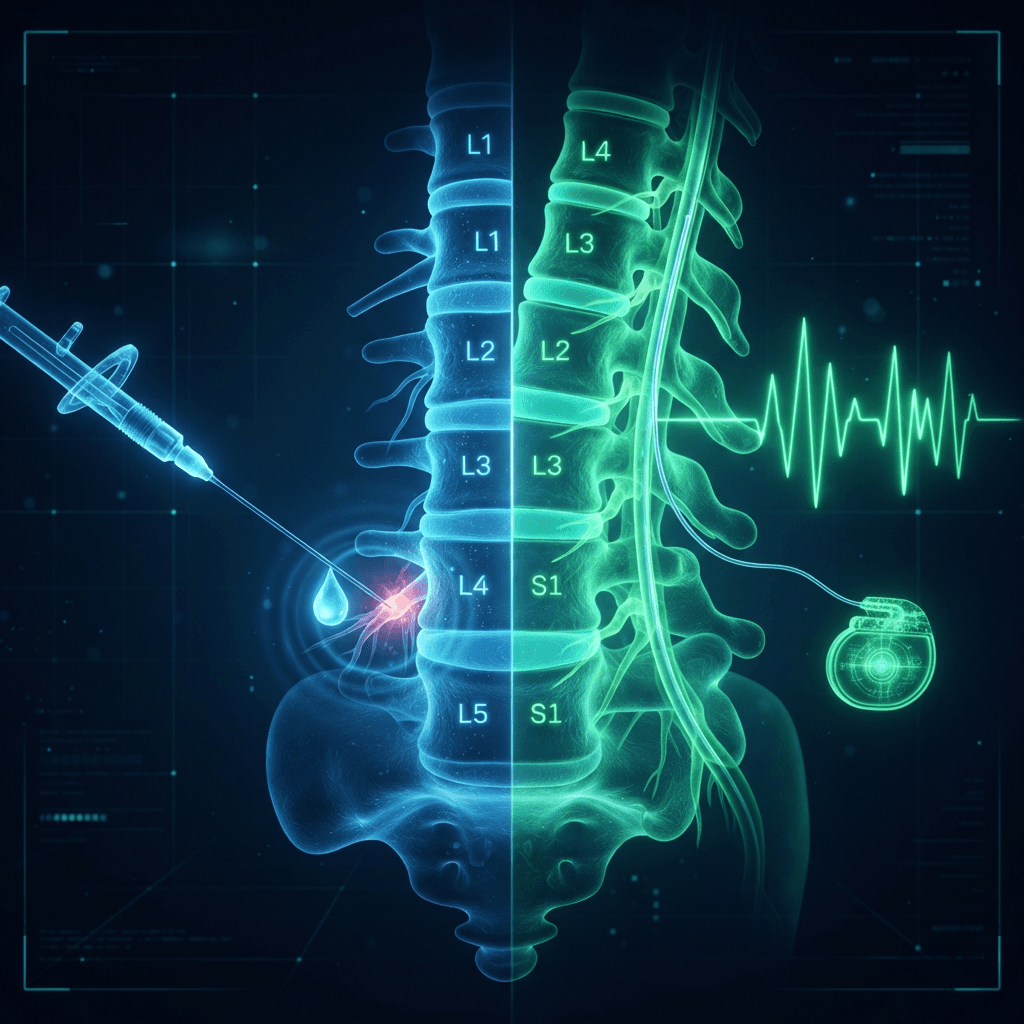
Spinal Injections vs. SCS: Side-by-Side Comparison
| Spinal Injections | Spinal Cord Stimulation | |
|---|---|---|
| What it is | Image-guided injection of a steroid and/or local anesthetic near an irritated nerve or joint | Small implanted device that sends mild electrical pulses to the spinal cord to change how pain signals reach the brain |
| Invasiveness | Minimal | Moderate (trial, then implant surgery) |
| Procedure | Outpatient, about 15 to 30 minutes | Temporary trial of about a week, then a permanent implant if the trial works |
| How long relief lasts | Days to several months | Ongoing for as long as the device is in use and working |
| Best suited for | Pain from an inflamed nerve or joint with a matching exam and imaging, such as sciatica, disc-related arm or leg pain, facet or SI joint pain | Long-lasting nerve-related or back and leg pain, including persistent pain after spine surgery, that has not responded to conservative care |
| Goal | Reduce inflammation and pain, identify the pain source, and support rehabilitation | Longer-term pain control with less reliance on pain medication |
| Trial before commitment | Each injection is itself a test of how you respond | Temporary trial of about a week before committing |
| Main risks | Temporary soreness and blood sugar rise, rare serious complications, cumulative steroid exposure | Lead movement or breakage, infection, possible revision or removal |
| Recovery | Rest the first day; resume normal activity the next day as comfortable | About 6 weeks of activity limits after the permanent implant |
| Insurance | Usually covered when criteria are met; ablation often needs two positive diagnostic blocks | Covered by Medicare and many private plans with prior authorization; requires a successful trial |
| Reversibility | Effects wear off on their own | Device can be switched off or removed |
| When it is used | Often tried earlier, after rest, medication and therapy | Usually considered after medications, therapy and injections have not given enough relief |
Spinal Injections
Spinal injections place anti-inflammatory medicine, usually a corticosteroid with a local anesthetic, next to an irritated spinal nerve or joint. The physician uses live X-ray (fluoroscopy), ultrasound or CT guidance to place the medication precisely.
They reduce inflammation and can make physical therapy easier, but they do not repair the underlying problem.
Common Injection Types
- Epidural steroid injections
- Facet joint injections
- Medial branch blocks
- Selective nerve root blocks
- Sacroiliac (SI) joint injections
Commonly Used For
- Sciatica
- Herniated discs
- Pinched nerves
- Spinal stenosis
- Facet arthritis
- SI joint pain
Injection Advantages
- Minimally invasive: about 15 to 30 minutes as an outpatient visit, and most people go home the same day
- Relief after a targeted injection can help pinpoint the pain source
- Most consistent short-term benefit is for radiating arm or leg pain caused by an irritated nerve, such as from a disc
- A window of lower pain can help you progress in physical therapy and strengthening
- May help some people avoid or delay surgery
- A steroid typically starts working within 2 to 7 days
- For facet pain, radiofrequency ablation can extend relief, often around 6 to 12 months
Injection Disadvantages
- Relief is temporary, from days to several months, and some people get little benefit
- Does not repair a disc or reverse arthritis or spinal narrowing
- Evidence is weaker for general low back pain and for long-term benefit in spinal stenosis
- Common short-term effects include soreness, flushing, trouble sleeping and a temporary rise in blood sugar
- Uncommon risks include infection, bleeding, allergic reaction and spinal-fluid-leak headache; rare serious events are possible
- Repeated or high cumulative steroid doses can affect bone density, blood sugar and mood, so injections are spaced out and limited
Spinal Cord Stimulation (SCS)
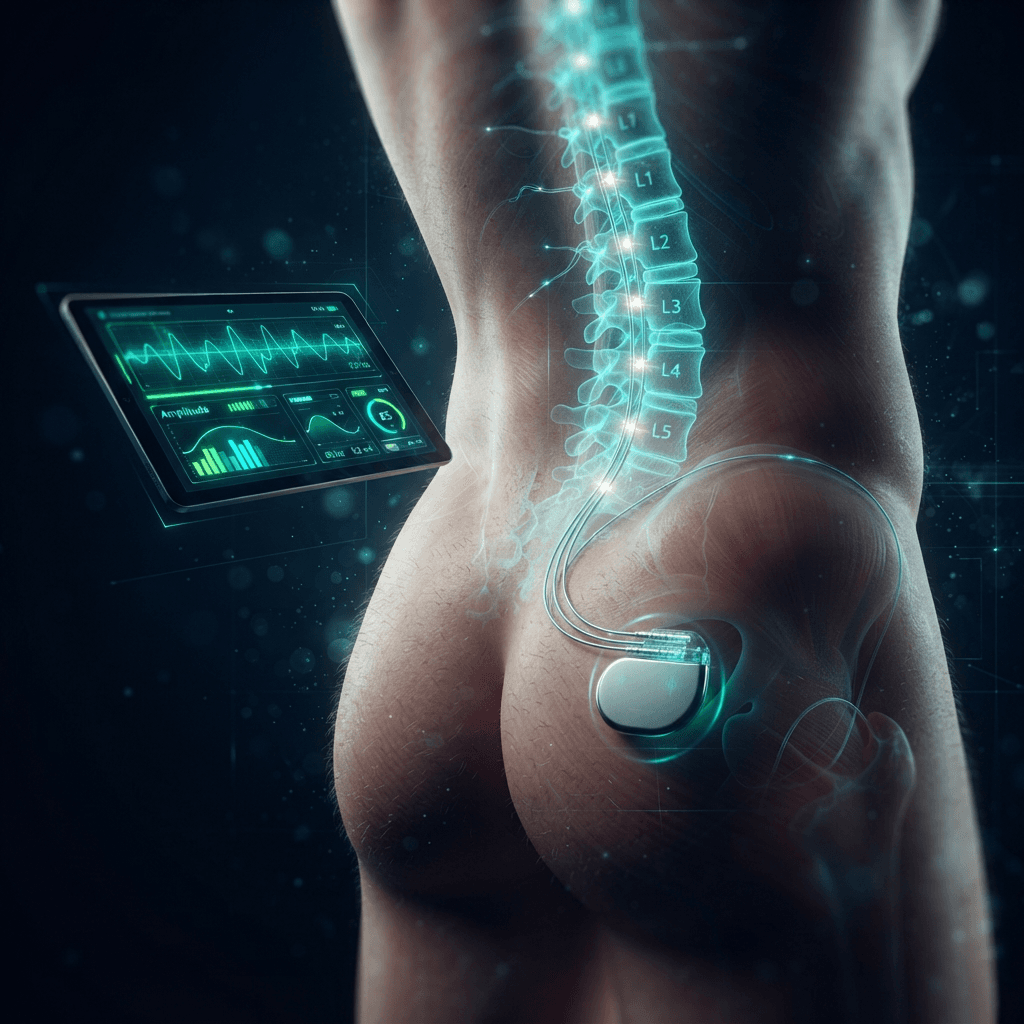
SCS uses thin leads placed in the epidural space near the spinal cord and a small battery-powered pulse generator placed under the skin, usually in the buttock or abdomen. The pulses interrupt pain signals on their way to the brain.
SCS does not remove the source of pain. It changes how the nervous system carries and interprets the signal.
Before a permanent implant, you try a temporary trial of about a week using external equipment. A permanent system is considered only when the trial gives meaningful relief, commonly 50% or more.
SCS Advantages
- The trial lets you try the therapy in daily life before committing
- Opioid-free, non-drug therapy; one randomized trial found SCS patients needed opioids less often than people who had repeat spine surgery
- Published long-term success rates range from about 47% to 74%, with success usually meaning at least 50% pain relief
- Reversible: the system can be switched off or surgically removed
- Programs can be fine-tuned by the clinic; several waveform options exist, including options with little or no tingling
- FDA-approved for chronic trunk and limb pain, including intractable low back and leg pain and failed back surgery syndrome; some systems are approved for painful diabetic neuropathy
- Battery life of up to 11 years has been reported with optimal programming
SCS Disadvantages
- Implantation is surgery; although minimally invasive, it carries real risks
- Lead migration and lead breakage are the most common hardware problems, and some require a revision procedure
- Infection is reported in roughly 2% to 5% of cases; serious nerve injury is rare
- Not everyone responds, and it reduces pain more often than it removes it; one real-world study found about 14% of devices were eventually removed
- About 6 weeks of limits on bending, twisting and lifting after the implant
- MRI is only possible if the device is labeled MRI-compatible, and diathermy should be avoided
- Needs medical and psychological screening, insurance prior authorization, ongoing programming visits and eventual battery care
Which One Is Right for You?
There is no single winner. For many people, the path starts with conservative care and, when appropriate, injections. SCS is usually considered when pain has lasted months to years and medication, physical therapy and injections have not given enough relief.
Several weeks without improvement
Pain lasting several weeks without improvement from rest, medication and therapy is where injections are commonly considered.
Three to six months or more
Pain lasting more than three to six months despite those steps, including injections, is where SCS may be worth discussing.
Pain that matches your imaging
Pain that follows a specific nerve or joint and matches an MRI or CT is a good fit for a targeted injection.
Burning, shooting or electric pain
Burning, shooting or electric-type nerve pain, or persistent pain after spine surgery, is the kind SCS is known to help.
Surgery first? If surgery is expected to fix a structural cause, that conversation comes first. Progressive weakness or bladder or bowel changes need urgent evaluation, not either treatment first.
Your preference matters. If you prefer to avoid an implant, injections and other less invasive options come first. If you want a testable, reversible, opioid-free option for long-lasting pain, the SCS trial offers a way to try it.

Steps on the Same Pathway
Injections and SCS are better understood as steps on the same pathway than as rivals. Injections can reduce inflammation and clarify the pain source, helping your physician decide whether SCS makes sense.
Results tend to be best when treatment is combined with an active rehabilitation plan.
Conservative care
Rest, medication and physical therapy come first for most people.
Spinal injections
When appropriate, injections reduce inflammation and clarify the pain source.
SCS trial
A temporary trial of about a week shows how the therapy works in daily life.
Permanent implant
Considered only when the trial gives meaningful relief, commonly 50% or more.
Your Appointment
Questions to Bring
- Does my imaging match my symptoms, and which structure is the likely pain source?
- What relief can I realistically expect, and for how long?
- How many injections are reasonable for me in a year?
- Would I be a candidate for an SCS trial, and what result would count as success?
- What are the risks that apply to my health, such as diabetes or blood thinners?
- What does my insurance cover, and will your team handle prior authorization?
Emergency Care
When to Seek Urgent Care
Talk with a doctor about new or worsening pain before starting treatment. Seek emergency care for:
- New weakness
- Loss of bladder or bowel control
- Numbness in the groin or saddle area
Find Out Which Option Fits Your Pain
Our board-certified interventional pain specialists have served Queens, New York since 2004. Book an evaluation to discuss injections, SCS, or another approach.
9701 66th Ave, Rego Park, NY 11374
queenspainclinic.com/contact
Medical disclaimer: This article is general education, not personal medical advice. Individual results vary. Statistics are drawn from published studies cited on the Queens Pain Clinic knowledge catalogue pages and differ by condition, device and study. Talk with a doctor about new or worsening pain before starting treatment, and seek emergency care for new weakness, loss of bladder or bowel control, or numbness in the groin or saddle area.