Spinal Cord Stimulation
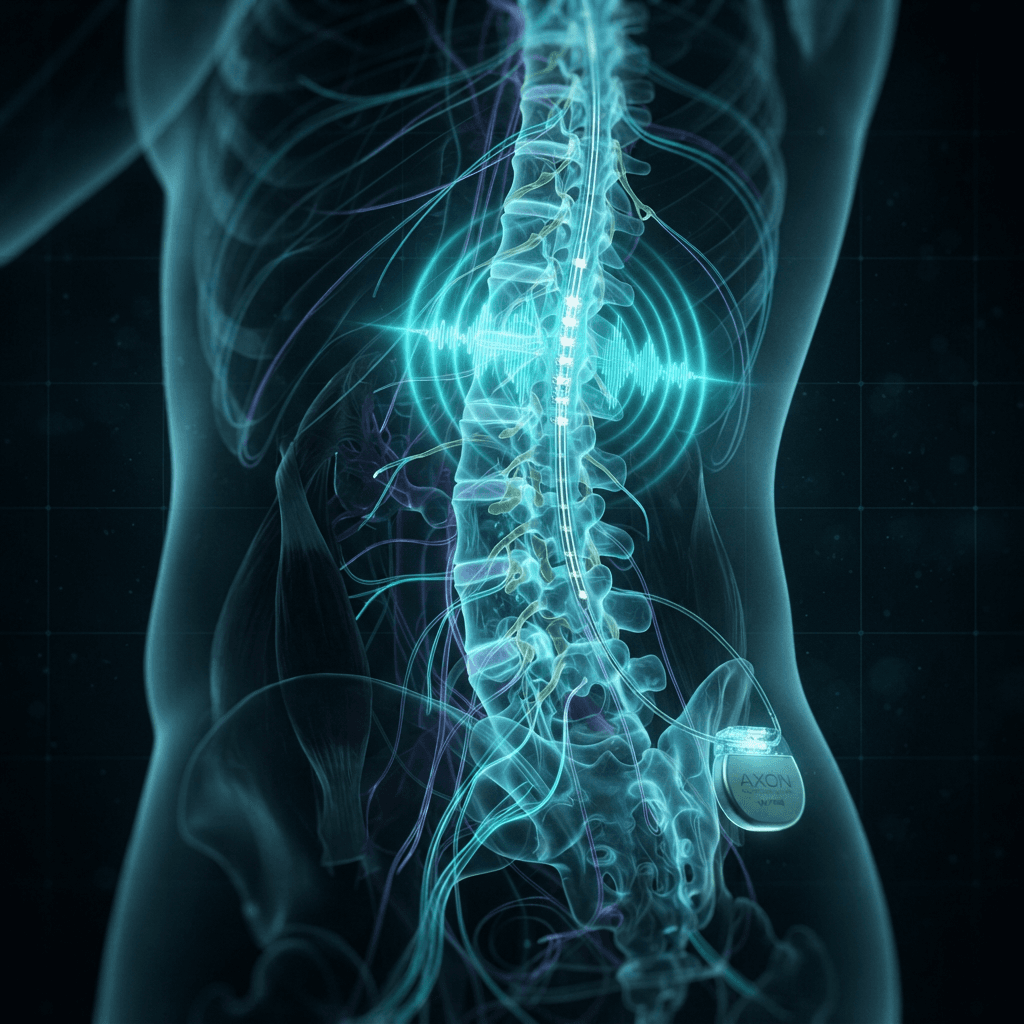
Spinal cord stimulation (SCS) uses a small implanted device that sends mild electrical pulses to the spinal cord to change how pain signals reach the brain. It is usually considered after medications, therapy and injections have not given enough relief, and a trial period comes before any permanent implant.
Spinal cord stimulation (SCS) is a treatment for chronic pain in which a small implanted device sends mild electrical pulses to the spinal cord to change how pain signals reach the brain. It is usually considered after medications, physical therapy and injections have not given enough relief.
The Numbers Behind That
Published long-term success rates for spinal cord stimulation range from about 47% to 74%, depending on the condition, the definition of success and the study. In a 2026 diabetic neuropathy study, pain was cut by half or more in 85% of patients. A 22-year series reported long-term success of 74.1% among implanted patients.
Medical disclaimer: This page is general education, not personal medical advice. Talk with your doctor about new or worsening pain before starting any new treatment. Reviewed by Queens Pain Management Clinic physicians, Oct 12, 2026.
The short version
What it treats
Long-lasting nerve-related or back and leg pain that has not responded to conservative care, including pain after spine surgery.
How you try it first
A temporary trial, usually about a week, with wires and an external battery. A permanent implant is considered only if the trial gives meaningful relief, commonly at least 50%.
How long it has been used
The FDA first approved SCS in 1989 for chronic pain from nerve damage in the trunk, arms or legs.
Is it reversible
Yes. The system can be switched off or removed.
Is it opioid-free
Yes. SCS is a non-drug therapy, and one randomized trial found patients randomized to SCS needed opioid pain medication less often than those who had repeat spine surgery.
How it works
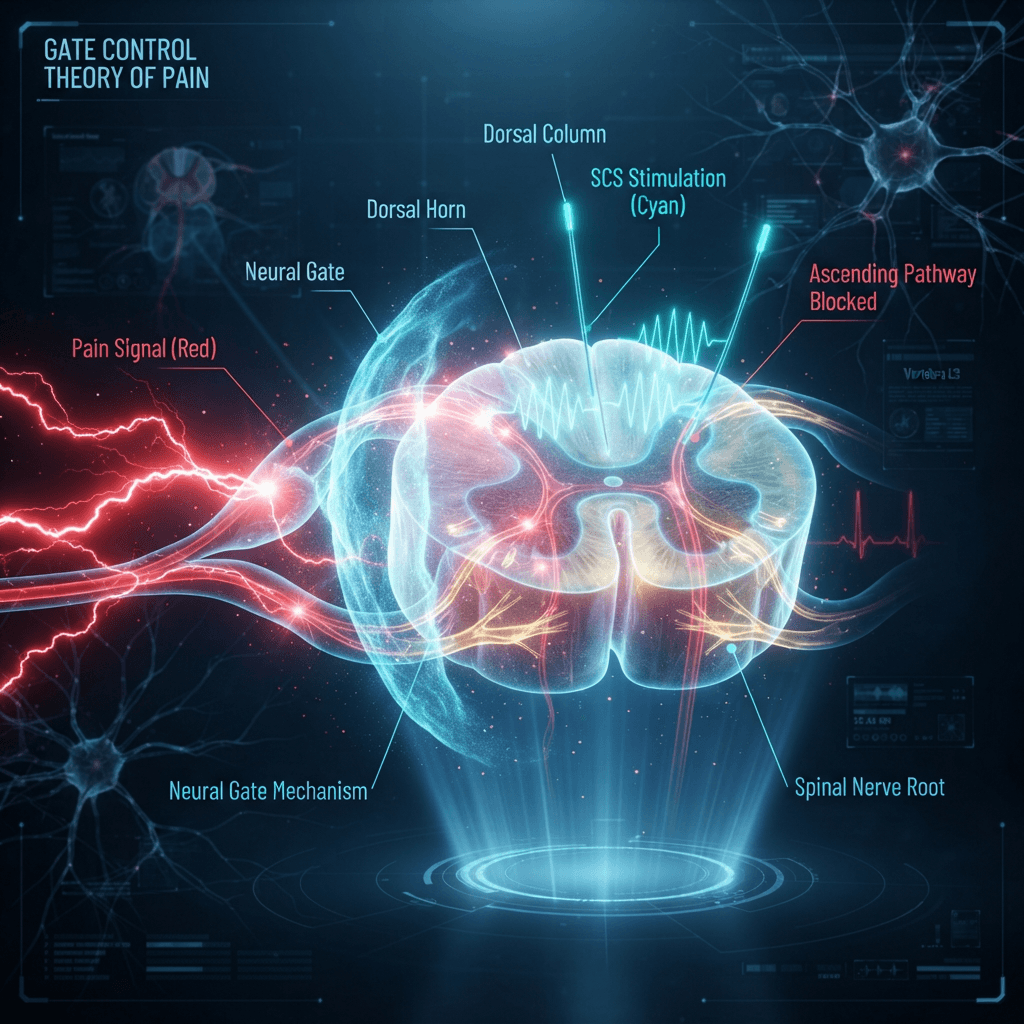
Electrical pulses target the dorsal columns of the spinal cord and interrupt pain signals on their way to the brain. SCS does not remove the source of pain; it changes how the nervous system carries and interprets the signal.
How a spinal cord stimulator works
A spinal cord stimulator has two parts: thin wires called leads, placed in the epidural space near the spinal cord, and a small battery-powered pulse generator placed under the skin. The pulses are aimed at the dorsal columns of the spinal cord and interrupt pain signals on their way to the brain. SCS does not remove the source of pain; it changes how the nervous system carries and interprets the signal.
A spinal cord stimulator works by delivering electrical pulses to the spinal cord that change how pain signals are processed, based on the gate control theory of pain. The theory is the original rationale for treating chronic nerve pain with SCS. A complete mechanism is still being researched.
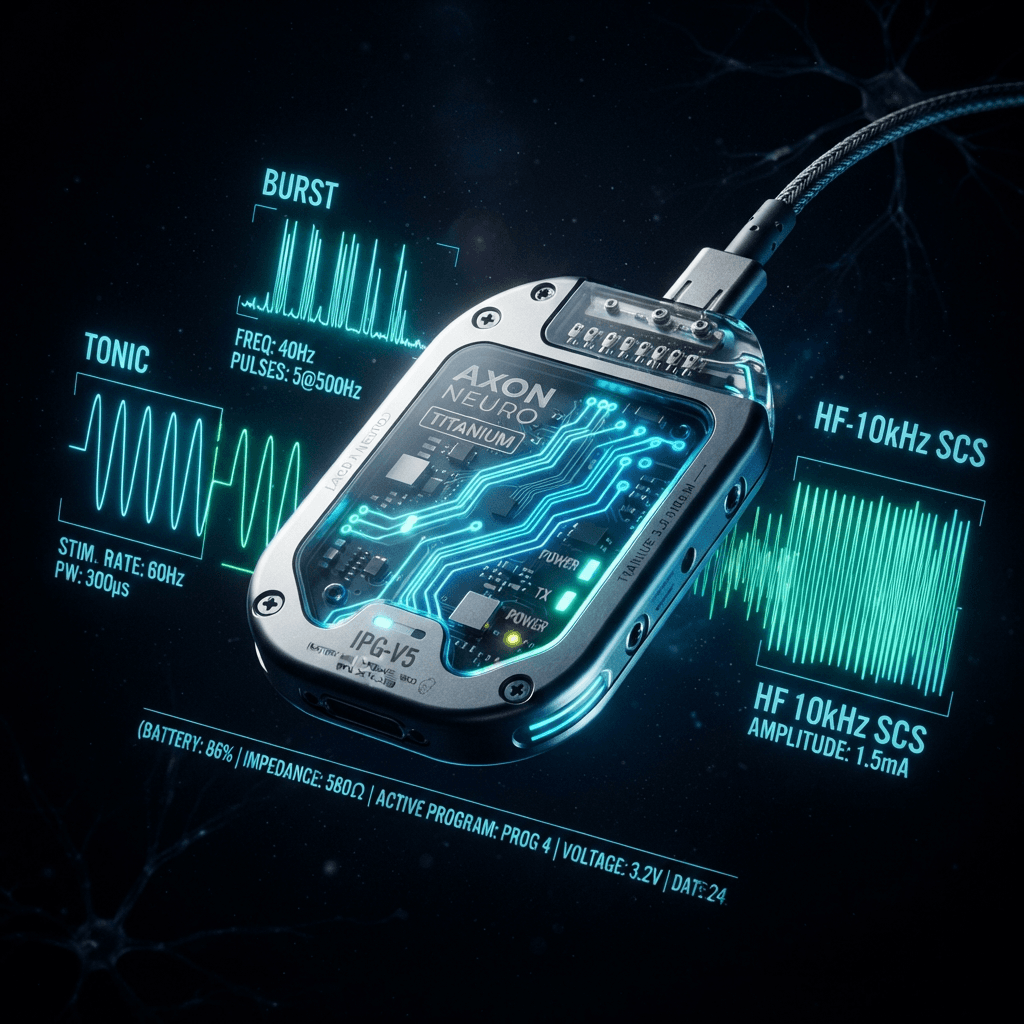
The three components
Who is a candidate for spinal cord stimulation?
You may be a candidate if you have chronic pain that has lasted months to years, has not improved enough with conservative treatment, and a physician has found a pain pattern that SCS is known to help. The final decision follows a physical exam, imaging review, a psychological screening and a successful temporary trial.
Signs SCS may be worth discussing
- Pain for more than three to six months despite medication, therapy and injections.
- Burning, shooting or electric-type nerve pain, or persistent pain after spine surgery.
- No surgery that is expected to fix the cause of the pain.
- A wish to reduce reliance on pain medication.
When SCS may not be suitable
Physicians commonly decline or delay SCS when there is:
- An active infection.
- A bleeding disorder or blood thinner that cannot be paused.
- Untreated psychological conditions.
- Pain with a cause that surgery can treat.
Why earlier evaluation matters
In one long-term series, pain relief was inversely related to the time between pain onset and implantation. A shorter wait may improve the odds of success.
Conditions and FDA status
Labels are editorial summaries of the sources listed below, not official ratings. Confirm current device labeling before publication. Checked October 12, 2026.
Failed back surgery syndrome (persistent spinal pain syndrome)
FDA-approved indicationFDA-approved indication; SCS was superior to conservative management and to reoperation in a published review.
Source: PubMed review
Chronic low back and leg pain
FDA-approved indicationFDA-approved indications for chronic trunk and limb pain, intractable low back pain and leg pain.
Source: PubMed review
Non-surgical refractory back pain
Expanded FDA label10 kHz SCS received an expanded FDA label for this indication.
Source: FDAnews
Painful diabetic neuropathy
Approved for some systemsApproved for some systems; Medtronic's Intellis and Vanta later received approval for it.
Source: BioWorld
Complex regional pain syndrome, peripheral neuropathy, angina and vascular limb pain
Reported to respondReported to respond in a 22-year clinical series. Confirm current labeling for each device.
Source: QxMD
Waveform types, in plain language
Which waveform suits a patient depends on pain location (back versus leg), personal preference for or against tingling, and what the trial shows.
Conventional (tonic), about 40–60 Hz
What you feel: A tingling sensation (paresthesia) over the painful area
Evidence: Responder rates of roughly 50–60% for radicular leg pain in randomized trials (medRxiv meta-analysis)
High-frequency, 10 kHz
What you feel: No tingling
Evidence: Higher responder rates for back pain than tonic in the same meta-analysis; offers paresthesia-free relief (review)
Burst
What you feel: Little or no tingling
Evidence: In the Sunburst study, over 69% of patients preferred burst to tonic and 65% reported no paresthesia; better continuous pain reduction in the meta-analysis (MassDevice)
Multiple-waveform systems
What you feel: Choice of tingling or no tingling
Evidence: One platform is described as the first FDA-approved system to give paresthesia-based and sub-perception therapy at once (Outsource Strategies)
Differential target multiplexed (DTM)
What you feel: No tingling
Evidence: Lower-energy programming reported to give meaningful relief (BioWorld)
The SCS journey: 6 steps, 1 decision
A permanent implant follows only a successful trial.
Consultation and imaging
Your physician reviews your history, imaging and past treatments.
Medical and psych screening
A psychological and medical evaluation to confirm SCS is a good fit.
Temporary trial (~1 week)
A short outpatient procedure, followed by about a week of testing the therapy in daily life.
Decision point
You and your physician review the trial results together. A permanent implant is considered only when the trial gives about 50% or more relief; otherwise you and your physician discuss other options.
Permanent implant
If you proceed, the permanent system is placed and programmed as an outpatient procedure or with a one-night stay.
Programming and follow-up
Programming visits, device checks and a remote app. Your clinic adjusts settings as your pain changes, with a 6-week recovery period limiting bending, twisting and lifting.
The 50% threshold
A permanent implant is considered only when the trial gives about 50% or more relief; otherwise you and your physician discuss other options. This is why the trial exists — it lets you test the therapy in your own life before committing to the permanent system.
Evidence and success rates
Published long-term success rates for spinal cord stimulation range from about 47% to 74%, depending on the condition, the definition of success and the study. Success usually means at least 50% pain relief, so most patients improve but not everyone responds. Checked October 12, 2026.
| Evidence | Result | Source |
|---|---|---|
| Randomized trial, SCS vs repeat spine surgery (failed back surgery syndrome) | Fewer patients crossed over from SCS than from reoperation (5 of 24 vs 14 of 26); reoperation patients needed more opioids | Neurosurgery 2005 |
| Systematic review of that evidence | 37.5% of SCS patients had 50% or more relief vs 11.5% after reoperation | Univ. of Birmingham |
| 22-year single-program series | Early success 80%; long-term success 74.1% among implanted patients at about 8 years | QxMD |
| Real-world outcomes study | 86.1% passed the trial; overall explant rate 14.1% | Dove Medical Press |
| Diabetic neuropathy study, 2026 | Pain cut by half or more in 85% of patients | BioWorld |
| General long-term range | 47% to 74% | ASAP Pain Docs |
Success is measured against a threshold
Most studies count at least 50% pain relief as a response.
Outcomes depend on the condition
Leg pain and nerve pain tend to respond more reliably than axial back pain with older waveforms, which is one reason newer waveforms were developed.
The trial predicts the result
A permanent implant is offered only after a trial reaches the response threshold.
SCS reduces pain; it rarely removes it
Function, sleep and medication use are also tracked.
Risks and complications
The most common problems with spinal cord stimulators are hardware-related, such as a lead moving or breaking, while serious injury to the nerves is rare. Many hardware problems can be fixed with a minor revision procedure.
Rates vary a lot between studies because of different devices, anchoring techniques and follow-up. Treat these as ranges, not promises.
| Complication | Reported rate | Source |
|---|---|---|
| Lead migration | 13.2% in a pooled review; 22.6% in a 707-patient series; 1.17% in a 681-patient series using anchors | PMC table, Cleveland Clinic series, DGNC 2016 |
| Lead breakage | 9.1% pooled; 6% in the Cleveland Clinic series | PMC table, Cleveland Clinic |
| Infection | 2.45% in a multicenter study of 2,737 implants; 3.4% pooled; 4.5% in the Cleveland Clinic series | Neuromodulation 2017, PMC table, Cleveland Clinic |
| Pain at the generator site | 12% in the Cleveland Clinic series | Cleveland Clinic series |
| Epidural hematoma, or CSF leak | 0.3% each (pooled) | PMC table |
| Paralysis | 0.03% (pooled) | PMC table |
| Serious adverse events and revision, in failed back surgery trials | Serious events 10%; revision surgery 16% | medRxiv meta-analysis |
| Permanent device removal (explant) | 14.1% in a real-world study | Dove Medical Press |
What lowers the risk
- Strict sterile technique, an occlusive dressing and post-operative antibiotics were associated with lower infection rates.
- Anchoring the leads reduced lead migration in a large multicenter analysis (DGNC 2016).
- Diabetes was linked to a higher infection rate (9% vs 4%) in the Cleveland Clinic series; tight blood-sugar control before surgery is sensible.
- The temporary trial itself carried few complications: lead migration in 5 of 707 patients (0.7%).
When to call the clinic
- Redness, swelling, drainage or fever at the incision.
- New weakness or numbness.
- A sudden change or loss of stimulation.
- Severe headache that is worse upright.
Call (718) 275-5200 or go to the nearest emergency room for any of the above.
Recovery and living with a spinal cord stimulator
After a permanent implant, most patients limit bending, twisting and lifting for about six weeks while scar tissue forms around the leads and holds them in place. The implant is done as an outpatient procedure or with a one-night stay.
| Topic | What patients should know | Source |
|---|---|---|
| Activity | Restrict bending, twisting and heavy lifting for about 6 weeks; your surgeon sets the exact limits | Spine.co |
| MRI | Older systems were not MRI-compatible; compatibility depends on the device model. Always tell the radiologist you have a stimulator before any scan | Spine.co |
| Systems without MRI labeling | Should not be exposed to MRI; heating or movement of the device or leads can occur | Boston Scientific brochure |
| Diathermy | Patients should not have diathermy treatment; the stimulator can also interfere with other implanted devices | Boston Scientific brochure |
| Battery life | A device with optimal programming has been reported to last up to 11 years; rechargeable and non-rechargeable models differ | BioWorld |
| Follow-up | Programming visits, device checks and a remote app; your clinic adjusts settings as your pain changes | clinic protocol |
Can I drive?
Rules differ by device and by waveform. Ask your physician and refer to the manufacturer's current guidance for the models we implant.
Can I fly or pass airport security?
Carry your device ID card and tell security staff. Contact our clinic for specific travel guidance.
Can I exercise?
Gentle walking is usually encouraged early. Your surgeon will give you a specific activity timeline.
Insurance and cost
Spinal cord stimulation is covered by Medicare and many private insurers when specific medical criteria are met, and many plans require prior authorization before the trial and again before the permanent implant. Medicare's National Coverage Determination 160.7 allows coverage when its criteria are met. Private insurers publish their own policies.
What insurers commonly look for
- A documented diagnosis and pain history.
- Failure of conservative treatments such as medication and physical therapy.
- A psychological evaluation before the trial.
- A successful trial, commonly defined as at least 50% pain relief, before the permanent implant.
Insurance accepted
We accept Medicare, Medicaid and major commercial plans. Contact us to verify your specific coverage.
Prior authorization
Our team submits the authorization for your trial and implant.
Out-of-pocket costs
Your cost depends on your plan's deductible and coinsurance; we give you an estimate before the procedure.
Financial counseling
Call (718) 275-5200 or book online to speak with our team.
Spinal cord stimulation vs. alternatives
Spinal cord stimulation is usually considered after less invasive options have not worked, and it is the only option here that you can test before committing. The table is a general overview for patients; the right path depends on the cause and location of the pain.
| Option | Typically used for | Invasiveness | How it differs from SCS |
|---|---|---|---|
| Physical therapy and exercise | First-line care for most back and limb pain | None | Builds strength and function; SCS is added when pain persists |
| Oral medications | Nerve pain, inflammation, flare-ups | None | Effects wear off between doses and can cause side effects; SCS is a non-drug therapy |
| Epidural steroid injections | Short-term relief of inflamed nerve roots | Minimal | Relief is temporary; SCS aims for long-term control |
| Radiofrequency ablation | Pain from specific facet or sacroiliac joints | Minimal | Targets individual nerves; SCS modulates signals across a spinal region |
| Repeat spine surgery | Pain with a correctable structural cause | High | In one randomized trial, SCS patients were less likely to switch treatments and needed fewer opioids than reoperation patients (Neurosurgery 2005) |
| Dorsal root ganglion (DRG) stimulation | Focal pain such as foot or groin pain | Moderate | Targets a nerve cluster; compared with SCS in the literature |
| Spinal cord stimulation | Chronic nerve-related or back and leg pain that has not responded to other care | Moderate | Reversible, testable with a trial, and opioid-free |
Frequently asked questions
Each answer opens with a direct statement so it can stand alone in search snippets and AI answer engines.
What is a spinal cord stimulator?
A spinal cord stimulator is an implanted device that sends mild electrical pulses to the spinal cord to interrupt pain signals before they reach the brain. It has thin leads in the epidural space and a small battery under the skin, and it is used for chronic pain that has not responded to other treatment.
Does a spinal cord stimulator really work?
For many people, yes. Published long-term success rates range from about 47% to 74%, where success usually means at least 50% pain relief. It does not work for everyone, which is why a temporary trial comes first.
What conditions does spinal cord stimulation treat?
It is FDA-approved for chronic pain of the trunk and limbs, including intractable low back pain, leg pain and pain after failed back surgery. Some systems are also approved for painful diabetic neuropathy and non-surgical refractory back pain. Other nerve pain conditions have also been treated.
How long is the spinal cord stimulator trial?
The trial usually lasts about a week; sources describe 3 to 7 days or 7 to 10 days depending on the device and clinic. Temporary leads connect to an external battery so you can test the therapy in daily life. A permanent implant is considered when pain relief reaches about 50% or more.
Is spinal cord stimulator surgery major surgery?
The implant is a minimally invasive procedure, done as outpatient surgery or with a one-night stay. Leads are placed through a needle in the epidural space and connected to a generator under the skin. It is still surgery, so it carries risks such as infection or lead movement.
What are the risks of a spinal cord stimulator?
The most common risks are lead migration, lead breakage and infection, with reported infection rates of roughly 2% to 5%. Serious nerve injury is rare. Many hardware problems are fixed with a minor revision procedure.
How long does recovery take?
Patients usually restrict bending, twisting and lifting for about six weeks while the leads settle in place. Incision soreness improves over the first days to weeks. Your surgeon gives you specific limits and a return-to-work timeline.
Can I have an MRI with a spinal cord stimulator?
Only if your device is labeled MRI-compatible and the scan follows the manufacturer's conditions. Older systems were not compatible. Always tell your radiologist and the MRI technologist that you have a stimulator before any scan.
How long does a spinal cord stimulator battery last?
Battery life depends on the model, programming and use. One report describes up to 11 years with optimal programming. Rechargeable devices need periodic charging; non-rechargeable devices need a replacement procedure when the battery runs out.
Will a spinal cord stimulator get rid of my pain?
It is designed to reduce pain, not to eliminate its cause. Many patients aim for at least 50% relief along with better sleep, activity and less medication. Your physician will set realistic goals with you.
Can a spinal cord stimulator be removed?
Yes. The system is reversible and can be switched off or surgically removed. In one real-world study, about 14% of devices were eventually removed.
Does insurance cover spinal cord stimulation?
Medicare covers it under National Coverage Determination 160.7 when its criteria are met, and many private insurers cover it with prior authorization. Requirements usually include failed conservative care and a successful trial. Our team checks your benefits before you commit.
How do I know if I'm a candidate?
You may be a candidate if you have long-lasting nerve-related or back and leg pain that has not improved with medication, therapy or injections. A physician reviews your history and imaging, and a trial confirms whether it helps you. Book a consultation to find out.
Glossary
Plain-language definitions for key research and treatment terms used throughout this page.
Spinal Cord Stimulation (SCS)
A treatment in which an implanted device sends electrical pulses to the spinal cord to change how pain signals reach the brain
Epidural Space
The area just outside the membrane surrounding the spinal cord, where SCS leads are placed
Leads
Thin wires with electrodes that deliver electrical pulses to the dorsal columns of the spinal cord
Implantable Pulse Generator (IPG)
The battery and control unit placed under the skin, usually in the buttock or abdomen
Dorsal Columns
The back portion of the spinal cord that carries sensory signals, including pain, toward the brain
Gate Control Theory
The original rationale for SCS: electrical signals can close a "gate" in the spinal cord that would otherwise let pain signals through
Paresthesia
A tingling sensation over the painful area produced by conventional tonic SCS
Trial Period
A temporary test of about one week using external equipment before a permanent implant is considered
Explantation
Surgical removal of the SCS device; in one real-world study the rate was 14.1%
Failed Back Surgery Syndrome
Persistent pain after spine surgery; one of the most common FDA-approved indications for SCS
Tonic Stimulation
Conventional SCS at about 40–60 Hz that produces a tingling sensation
Burst Stimulation
A waveform pattern with little or no tingling; over 69% of patients in the Sunburst study preferred it to tonic
Ready to explore spinal cord stimulation?
Our physicians at Queens Pain Management Clinic can help you decide whether spinal cord stimulation fits your situation — and walk you through the trial process step by step.
Benefits of Spinal Cord Stimulation
SCS offers a long-term, adjustable option for chronic pain that has not responded to other treatment, with a trial period that lets you test the therapy before committing.
SCS is a considered next step for chronic pain that has not improved with conservative treatment. A successful trial, careful patient selection and realistic expectations are what make it work.
- Usually reserved for pain not helped by other treatment
- A trial period comes before permanent implantation
- Relief varies; many patients improve but few become pain-free
- The device is adjustable and removable