PRP Therapy for Pain Management
Platelet-rich plasma (PRP) is an injection made from your own blood, concentrated in a centrifuge and placed into a painful joint, tendon or ligament. It aims to support healing and reduce pain over weeks to months. Evidence is stronger for knee osteoarthritis and some tendon injuries than for other conditions.
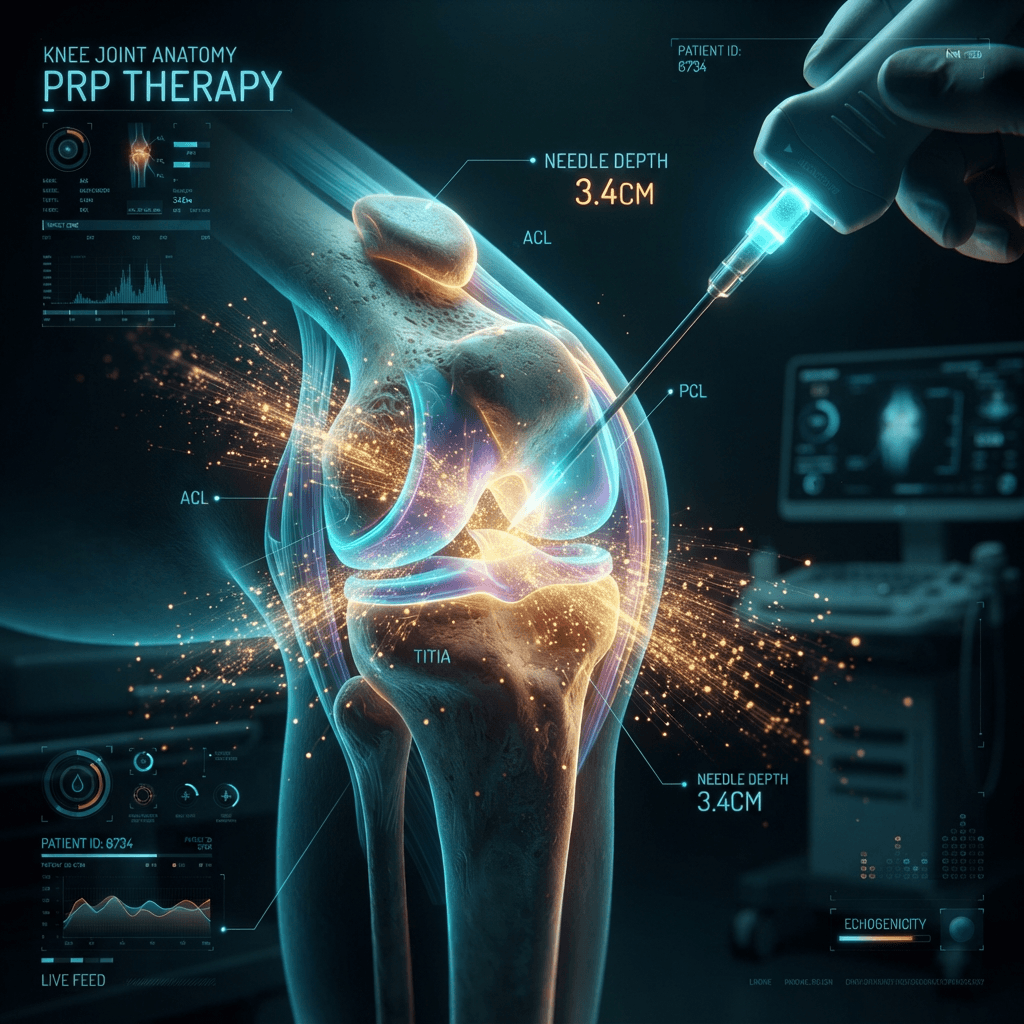
Platelet-rich plasma (PRP) therapy is an injection made from your own blood. A small blood sample is spun in a centrifuge to concentrate platelets, which carry growth factors involved in tissue repair. The concentrate is injected into a painful joint, tendon or ligament, usually under ultrasound guidance, to reduce pain and improve function over weeks to months.
The Numbers Behind That
The strongest evidence is for mild-to-moderate knee osteoarthritis, where a 2025 meta-analysis of 18 randomized trials covering 1,995 patients found clinically meaningful function gains at 1 to 12 months and pain relief at 3 and 6 months versus placebo.

Medical disclaimer: This content is educational and does not replace individual medical advice. Results vary. PRP is not FDA-approved for specific musculoskeletal indications. Talk with your doctor about new or worsening pain before starting any new treatment.
The Basics
What PRP therapy is
Platelet-rich plasma (PRP) therapy is an injection made from your own blood. A small blood sample is spun in a centrifuge to concentrate platelets, which carry growth factors involved in tissue repair. The concentrate is injected into a painful joint, tendon or ligament, usually under ultrasound guidance, to reduce pain and improve function over weeks to months.
What PRP can do
- Reduce pain and improve function for many patients with early-to-moderate joint degeneration
- Provide longer-lasting relief than corticosteroid in plantar fasciitis and facet/SI joint pain
- Offer a non-surgical option for chronic joint or tendon pain
- Work best when combined with a structured rehabilitation plan
What PRP cannot do
- PRP does not regrow severely worn cartilage or replace a joint
- Results vary; some patients respond strongly, others do not
- Platelet concentration and preparation method affect outcomes, and protocols are not yet standardized across clinics
FDA status — say it plainly
PRP is prepared with FDA-cleared devices and used legally by physicians, but it is not FDA-approved as a treatment for specific musculoskeletal conditions. Johns Hopkins describes its use in musculoskeletal medicine as investigational. Insurance generally does not cover it.
Mechanism
How PRP works
PRP uses your body's own biology. The process has four steps, and researchers still debate how large the clinical effect of the healing signals actually is.
Blood Draw and Concentration
About 10–60 mL of blood is taken from your arm. A centrifuge separates platelets and plasma from red cells, producing a concentrate with a platelet count several times higher than normal blood. The exact volume and centrifuge protocol vary by clinic and system used.
Targeted Injection
The concentrate is placed into the painful structure — a joint, tendon or ligament — with ultrasound or fluoroscopic guidance. Precise placement matters: imaging guidance reduces the chance of missing the target and is standard at most pain management practices.
Healing Signals
Platelets release growth factors that may modulate inflammation and support tissue repair. Researchers still debate how large the clinical effect of these mechanisms is. The size of the benefit varies by condition, preparation method and individual patient response.
Step 4: Healing signals
Platelets release growth factors that may modulate inflammation and support tissue repair. Researchers still debate how large the clinical effect of these mechanisms is. The size of the benefit varies by condition, preparation method and individual patient response — which is why honest pages say "may reduce pain" rather than "heals" or "cures."
Evidence by Condition
Conditions PRP is used for
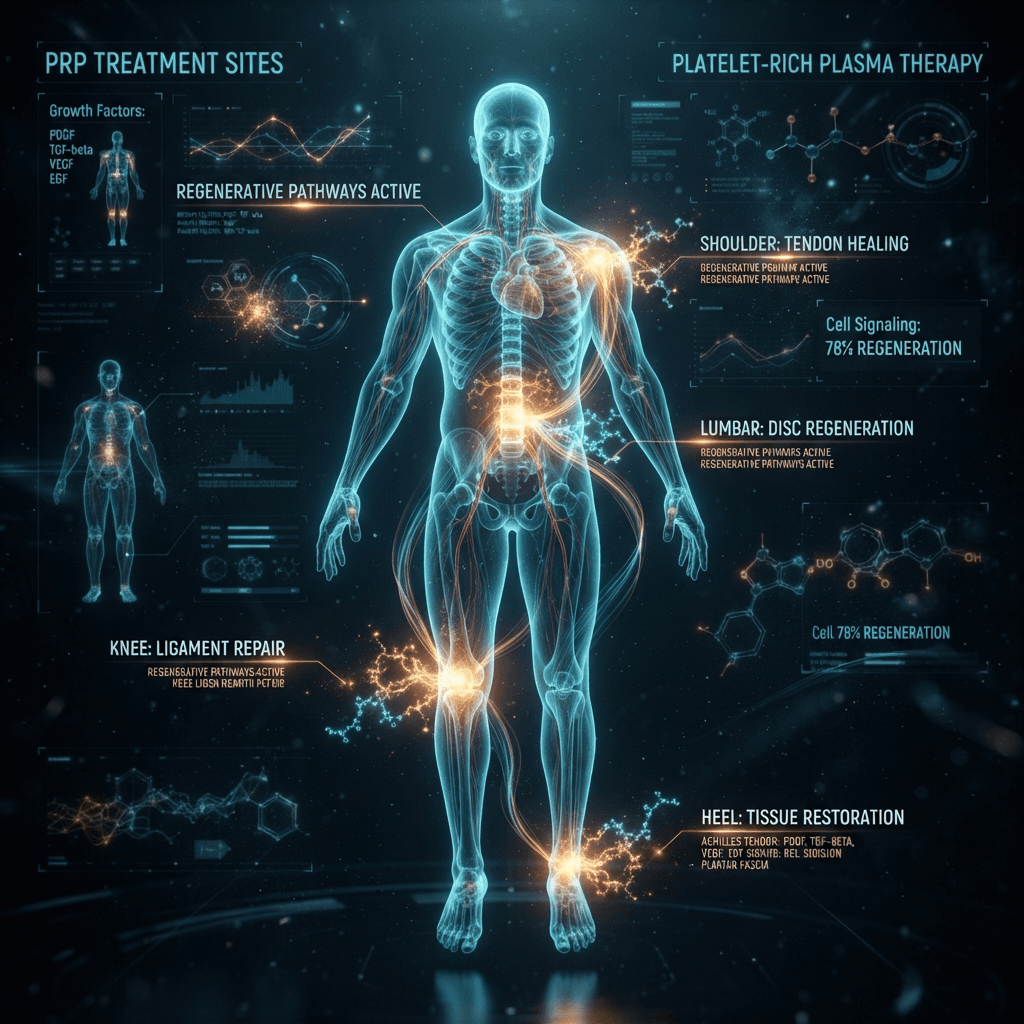
Evidence strength varies significantly by condition. The labels below are editorial summaries of the sources listed at the end, not official ratings. Checked October 12, 2026.
Knee Osteoarthritis
Strongest evidence; multiple meta-analysesA 2025 meta-analysis of 18 placebo-controlled trials (1,995 patients) found meaningful pain relief at 3 and 6 months and functional gains lasting up to 12 months. A separate 2025 review of six high-quality randomized trials (1,162 patients) reported significant improvement at 6 and 12 months versus hyaluronic acid, corticosteroid or placebo. An umbrella review of nine meta-analyses found results on pain scores and quality of life were inconsistent, mostly because preparation and injection methods differ. PRP does not rebuild lost cartilage.
Source: 2025 Meta-Analysis (18 trials, 1,995 patients)
Tendinopathy (Patellar, Elbow, Rotator Cuff)
Mixed; varies by tendonA 2018 meta-analysis of 21 trials (1,031 participants) found PRP reduced long-term pain for rotator cuff injuries and lateral epicondylitis. Both patellar-tendon trials in a 2015 review favored PRP for pain at 3 and 12 months. Results are not uniform across tendons — support is best for patellar tendon and tennis elbow, and evidence is lacking for Achilles tendinopathy. Loading-based physical therapy remains first-line.
Source: 2018 Meta-Analysis (21 trials, 1,031 participants)
Shoulder Pain (Rotator Cuff Tendinopathy)
Promising, protocols unsettledPRP is sometimes used for rotator cuff tendinopathy and partial tears when therapy has not worked. Eight randomized trials reviewed in 2021 varied widely in PRP method and comparison treatment, so the best protocol is still unsettled. Imaging confirmation and rehabilitation are required. PRP is not a substitute for surgery when a full-thickness tear needs repair.
Source: 2021 Review (8 randomized trials)
Tennis Elbow (Lateral Epicondylitis)
Conflicting evidenceThe evidence on PRP for tennis elbow is conflicting. A 2018 meta-analysis found less long-term pain with PRP, while an older 2014 systematic review concluded PRP was not efficacious. PRP is generally considered after rest, bracing and physical therapy fail, and is often preferred over repeat steroid injections because steroids can harm tendon tissue.
Source: 2018 Meta-Analysis vs. 2014 Systematic Review
Low Back Pain (Facet and Sacroiliac Joints)
Promising, limited certaintyA recent meta-analysis found PRP reduced pain more than corticosteroid injections at 3 months (about 1.3 points lower on pain scores), but the certainty of evidence is limited. SI joint involvement may account for roughly 15–30% of chronic low back pain. A 40-patient randomized trial found PRP gave longer relief than steroid at 3 months in SI joint pain. Diagnostic blocks or imaging should confirm the pain source first.
Source: Recent Meta-Analysis; 40-patient RCT
Hip Osteoarthritis
Emerging; comparable to HAPRP is an option for mild-to-moderate hip osteoarthritis, with results roughly comparable to hyaluronic acid injections in short-term reviews. Evidence is smaller than for the knee. A 2025 review of three studies (190 patients) found that adding hyaluronic acid to PRP did not improve outcomes. Ultrasound guidance is used for deep joint access.
Source: 2025 Review (3 studies, 190 patients)
Plantar Fasciitis (Heel Pain)
Better than steroid from 3 monthsFor chronic heel pain, PRP often outperforms corticosteroid injections after the first few months. A 2021 meta-analysis of 15 studies reported PRP gave better pain control than steroids from 3 months, lasting up to a year, with no short-term advantage for steroids. Many included studies had a high risk of bias, so results should be viewed with caution. Stretching and orthotics come first.
Source: 2021 Meta-Analysis (15 studies)
Neck Pain (Cervical Facet)
Thin evidence; limited dataEvidence for PRP in cervical facet and neck pain is thin and was not reviewed for this catalogue. This option should be discussed only with a physician who can provide a written evidence summary and a clear statement that data are limited.
Source: Limited data — physician review required
Research Summary
Evidence at a glance
Evidence is strongest for knee osteoarthritis and varies by condition. Nearly every source notes that preparation protocols are not standardized, which limits direct comparisons across studies. Checked October 12, 2026.
| Condition | Source | What it says | Strength |
|---|---|---|---|
| Knee osteoarthritis | 2025 meta-analysis (18 trials, 1,995 patients) | Meaningful pain relief at 3 and 6 months; functional gains up to 12 months versus placebo | Strongest |
| Knee OA vs HA/steroid | 2025 review (6 trials, 1,162 patients) | Significant improvement at 6 and 12 months versus hyaluronic acid, corticosteroid or placebo | High quality |
| Tendinopathy | 2018 meta-analysis (21 trials, 1,031 participants) | Reduced long-term pain for rotator cuff injuries and lateral epicondylitis | Mixed |
| Patellar tendon | 2015 review | Both patellar-tendon trials favored PRP for pain at 3 and 12 months | Moderate |
| Facet/SI joint back pain | Recent meta-analysis | PRP about 1.3 pain-score points better than corticosteroid at 3 months; limited certainty | Limited |
| Hip osteoarthritis | 2025 review (3 studies, 190 patients) | Results roughly comparable to HA; adding HA to PRP did not improve outcomes | Emerging |
| Plantar fasciitis | 2021 meta-analysis (15 studies) | Better pain control than steroids from 3 months up to one year | Moderate |
| FDA status | Johns Hopkins / FDA | PRP uses FDA-cleared devices; not FDA-approved for specific musculoskeletal conditions; use described as investigational | Regulatory |
Key caution across the board. Platelet concentration and preparation method affect outcomes, and protocols are not yet standardized across clinics. An umbrella review of nine meta-analyses found results on pain scores and quality of life were inconsistent for this reason. Benefit is likely for appropriate candidates, but size varies.
What to Expect
What to expect during a PRP injection
Step-by-step procedure
A PRP visit usually takes about an hour. Johns Hopkins reports most appointments run under an hour with effects building over 4 to 6 weeks.
Recovery timeline
Expect soreness for a few days, gradual improvement over 4 to 6 weeks, and the full effect around 3 months. Most people resume daily activities the next day but avoid strenuous exercise per clinic protocol.
Rest, ice if advised; avoid NSAIDs unless physician approves
Gentle movement; no heavy loading
Start guided physical therapy
Progressive strengthening
Follow-up, consider repeat treatment
Candidacy & Safety
Who is a good candidate, and is PRP safe?
Candidacy checklist
Good candidates have chronic joint or tendon pain that has not improved with rest, therapy or medication, and want a non-surgical option.
- Pain lasting more than 3 months
- Failed conservative care (therapy, bracing, NSAIDs)
- Diagnosis confirmed by exam and imaging
- No active infection at the injection site
- Platelet or bleeding disorder ruled out
- Medications reviewed (blood thinners, anti-inflammatories)
- Realistic expectations discussed
Best knee candidates
More likely to benefit
Mild-to-moderate OA (Kellgren-Lawrence grade 1–3), pain not controlled by exercise and NSAIDs, wanting to avoid or delay steroid injections or surgery.
Less likely to benefit
Bone-on-bone (grade 4), significant deformity or instability.
Safety and side effects
PRP is generally considered safe because it uses your own blood, so allergic reaction and rejection are unlikely.
PRP is not suitable if you have
- Active infection at or near the injection site
- Certain blood disorders or very low platelet counts
- Some cancers
- Blood thinners (discuss carefully with your physician)
Cost & Insurance
How much does PRP cost?
PRP for joint pain commonly costs about $500 to $1,200 per injection in the U.S., with published ranges as high as $2,500 depending on location and number of sessions. Insurance usually does not cover PRP because it is considered investigational for most uses, so patients typically pay out of pocket.
$500–$1,200
Typical range per injection
U.S. average
Up to $2,500
Published high end
Location and sessions vary
Usually not covered
Insurance coverage
Considered investigational
HSA/FSA eligible
Payment options
Contact clinic for financing
Comparison
PRP vs cortisone injections
Cortisone works faster, usually within days, but its effect often fades within weeks. PRP is slower, building over 4 to 6 weeks, but several meta-analyses report longer-lasting relief in plantar fasciitis and in facet and SI joint pain. Which is better depends on the condition, how fast relief is needed, and cost.
| Factor | PRP | Cortisone |
|---|---|---|
| Onset | Gradual, 4–6 weeks | Days |
| Typical duration | Months; up to a year in some studies | Weeks to a few months |
| Source | Your own blood | Synthetic steroid |
| Evidence for plantar fasciitis | Better pain control from 3 months (2021 meta-analysis, 15 studies) | Short-term relief only |
| Evidence for facet/SI joint pain | Lower pain at 3 months (meta-analysis; limited certainty) | Comparator |
| Tendon health | Not known to weaken tendon | Repeated use can harm tendon |
| Insurance | Usually not covered | Usually covered |
| Cost | Higher out of pocket | Lower |
Questions & Answers
Frequently asked questions
Each answer opens with a direct statement so it can be lifted on its own by search snippets and AI answer engines.
Does PRP work for pain?
It depends on the condition. The strongest evidence is for mild-to-moderate knee osteoarthritis, where a 2025 meta-analysis of 18 randomized trials (1,995 patients) found clinically meaningful function gains at 1 to 12 months and pain relief at 3 and 6 months versus placebo. Evidence is mixed for tendon problems and still developing for back pain.
Is PRP FDA-approved?
PRP is prepared with FDA-cleared devices and used legally by physicians, but it is not FDA-approved as a treatment for specific musculoskeletal conditions. Johns Hopkins describes its use in musculoskeletal medicine as investigational. Insurance generally does not cover it.
What conditions can PRP treat?
PRP is used for mild-to-moderate knee osteoarthritis, chronic tendon pain (patellar, elbow, rotator cuff), facet and sacroiliac joint back pain, hip osteoarthritis, plantar fasciitis and shoulder pain. Evidence strength varies by condition.
What can PRP not do?
PRP does not regrow severely worn cartilage or replace a joint. Results vary; some patients respond strongly, others do not. Platelet concentration and preparation method affect outcomes, and protocols are not yet standardized across clinics.
How long does a PRP appointment take?
A PRP visit usually takes about an hour. Blood is drawn, spun to concentrate platelets, and injected into the painful area, often with ultrasound guidance and a small amount of numbing medicine. Johns Hopkins reports most appointments run under an hour.
How long does PRP recovery take?
Expect soreness for a few days, gradual improvement over 4 to 6 weeks, and the full effect around 3 months. Most people resume daily activities the next day but avoid strenuous exercise per clinic protocol.
Who is a good candidate for PRP?
Good candidates have chronic joint or tendon pain that has not improved with rest, therapy or medication, and want a non-surgical option. Best knee candidates have Kellgren-Lawrence grade 1–3 disease. Bone-on-bone (grade 4) disease, significant deformity or instability are less likely to benefit.
Is PRP safe?
PRP is generally considered safe because it uses your own blood, so allergic reaction and rejection are unlikely. The main risks are soreness, bruising, temporary swelling and, rarely, infection, bleeding or injury to nearby structures — the same risks as any needle procedure.
How much does PRP cost?
PRP for joint pain commonly costs about $500 to $1,200 per injection in the U.S., with published ranges as high as $2,500 depending on location and number of sessions. Insurance usually does not cover PRP because it is considered investigational for most uses.
How does PRP compare to cortisone?
Cortisone works faster, usually within days, but its effect often fades within weeks. PRP is slower, building over 4 to 6 weeks, but several meta-analyses report longer-lasting relief in plantar fasciitis and in facet and SI joint pain. Repeated cortisone use can harm tendon tissue.
How does PRP compare to hyaluronic acid?
Both are joint injections for osteoarthritis. In knee and hip OA, trials show PRP is at least comparable to hyaluronic acid, and several knee studies favor PRP at 6 and 12 months. Combining the two may help in the knee but did not help in the hip in a 2025 review.
Can PRP replace surgery?
PRP is a non-surgical option for mild-to-moderate disease and does not replace surgery for severe joint damage, full tendon tears or nerve compression. Physical therapy remains first-line for most musculoskeletal pain, and PRP works best when combined with a structured rehabilitation plan.
Definitions
Glossary
Plain-language definitions for key research and treatment terms used throughout this page.
PRP
Platelet-rich plasma — a concentrate made from your own blood with a higher-than-normal platelet count.
Platelet
A blood cell fragment that carries growth factors involved in tissue repair and inflammation modulation.
Growth Factor
A protein released by platelets that signals cells to repair tissue and modulate inflammation.
Centrifuge
A machine that spins blood at high speed to separate platelets and plasma from red blood cells.
Ultrasound Guidance
Real-time imaging used to direct a needle precisely into a joint, tendon or ligament.
Osteoarthritis
Degenerative joint disease in which cartilage breaks down, causing pain and stiffness.
Tendinopathy
A chronic tendon condition involving pain, swelling and impaired function, often from overuse.
Kellgren-Lawrence
A grading scale (1–4) for knee osteoarthritis severity on X-ray; grade 4 is bone-on-bone.
Leukocyte-Rich PRP
PRP that retains white blood cells; whether this improves outcomes versus leukocyte-poor PRP is debated.
Investigational
A term used by Johns Hopkins and others to describe PRP use in musculoskeletal medicine — legal but not FDA-approved for specific indications.
References
Sources
Figures in this catalogue come from the abstracts and summaries of the sources below. Open the full text before publishing any number.
- 2025 meta-analysis of 18 placebo-controlled randomized trials (1,995 patients) on PRP for knee osteoarthritis
- 2025 review of six high-quality randomized trials (1,162 patients) comparing PRP versus hyaluronic acid, corticosteroid or placebo
- Umbrella review of nine meta-analyses on PRP for knee osteoarthritis (published 2025)
- 2018 meta-analysis of 21 trials (1,031 participants) on PRP for tendinopathy, rotator cuff and lateral epicondylitis
- 2015 review of patellar-tendon trials favoring PRP at 3 and 12 months
- 2021 review of eight randomized trials on PRP for shoulder pain and rotator cuff tendinopathy
- 2014 systematic review concluding PRP was not efficacious for tennis elbow
- Recent meta-analysis on PRP versus corticosteroid for facet and SI joint back pain
- 40-patient randomized trial on PRP versus steroid for SI joint pain
- 2025 review of three studies (190 patients) on PRP for hip osteoarthritis
- 2021 meta-analysis of 15 studies on PRP versus corticosteroid for plantar fasciitis
- Johns Hopkins Medicine, description of PRP use in musculoskeletal medicine as investigational
- FDA, cleared devices for PRP preparation; FDA status on musculoskeletal indications
Ready to explore PRP therapy for your pain?
Our physicians at Queens Pain Management Clinic can help you decide whether PRP fits your situation — and how it might work alongside your existing care.
Benefits of PRP Therapy
PRP uses your own platelets to support tissue repair, so it avoids foreign substances and can offer longer-lasting relief than a single steroid shot for some conditions.
PRP is a regenerative option that works best for selected conditions and well-chosen patients. Results vary, and an honest conversation about the evidence for your specific problem is part of the process.
- Strongest evidence: knee osteoarthritis and some tendon injuries
- Relief develops over weeks, not days
- Results vary between patients and conditions
- Not FDA-approved for specific musculoskeletal indications