Sacroiliac Joint Injection vs. Radiofrequency Ablation
Which Is Right for Your Pain?
An SI joint injection calms inflammation and helps confirm whether the joint is the source of your pain. Radiofrequency ablation (RFA) switches off the small nerves that carry pain from the joint, aiming for longer relief. Many patients start with an injection, and those who respond well may be considered for RFA.
A deep, aching pain in the buttock or low back that gets worse when you stand up from a chair, climb stairs, or roll over in bed may be coming from your sacroiliac (SI) joint. Research cited on our site estimates the SI joint accounts for roughly 15–30% of chronic low back pain cases, and it is often underdiagnosed.
Two common treatments are the SI joint injection and radiofrequency ablation (RFA). They are better understood as steps in the same pathway than as rivals.
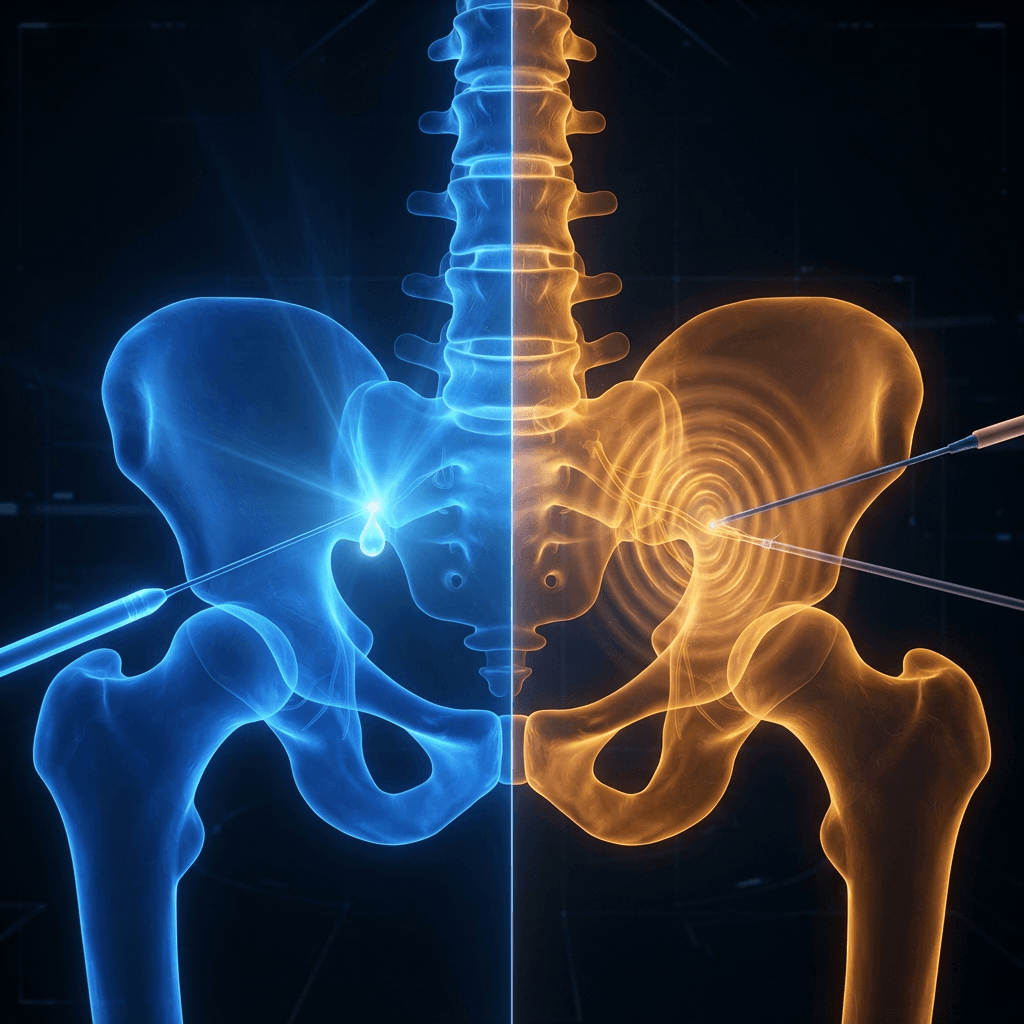
SI Joint Injection vs. RFA: Side-by-Side Comparison
| SI Joint Injection | Radiofrequency Ablation | |
|---|---|---|
| What it does | Delivers steroid and anesthetic into or around the joint | Uses heat to disable the nerves that carry pain from the joint |
| Main goal | Reduces inflammation and confirms the joint is the pain source | Aims for longer-term pain relief by interrupting the pain signal |
| Procedure time | 15 to 30 minutes | 30 to 60 minutes per region |
| Before you start | Evaluation and imaging review | Usually two positive diagnostic blocks first |
| Onset of relief | 2 to 5 days; up to 1 week | Often 2 to 4 weeks, after a possible flare |
| Typical duration | Weeks to several months | About 6 to 18 months for the SI joint |
| Recovery | Light activity in 24 to 48 hours | Light activity in 1 to 2 days |
| Can be repeated? | Yes, often in a series of 1 to 3 | Yes, once the nerve regrows |
| Best for | Sacroiliitis, SI joint dysfunction, post-partum pelvic pain, post-fusion SI pain | Confirmed SI joint pain needing longer relief after positive blocks |
| Insurance | Check your plan | Varies by payer; prior authorization is often needed |
Sacroiliac Joint Injection
An SI joint injection places a corticosteroid and a local anesthetic into or around the joint where the sacrum meets the iliac bone of the pelvis. Your doctor guides the needle with live X-ray (fluoroscopy) and contrast dye, and sometimes ultrasound, to place the medication.
It is both a diagnostic tool and a treatment: pain reduction after the numbing medicine takes effect suggests the SI joint is a pain source, while the steroid reduces inflammation and can provide lasting relief.
SI Joint Injection Basics
What to expect from the procedure and recovery.
Injection Advantages
- Quick: about 15 to 30 minutes, with same-day discharge
- Relief can start within days
- Treats inflammation directly inside the joint
- Doubles as a diagnostic test for the SI joint
- A positive response can open the door to longer-term options such as RFA
- Can be repeated as part of a treatment series
Injection Disadvantages
- Relief is often temporary, from weeks to several months
- Results vary from person to person
- Does not repair the underlying joint problem
- May need a series of 1 to 3 injections
- Procedure risks exist, including soreness, infection, bleeding, or reaction to medication
- Steroids can affect blood sugar for a short time, so tell your doctor if you have diabetes
Radiofrequency Ablation (RFA)
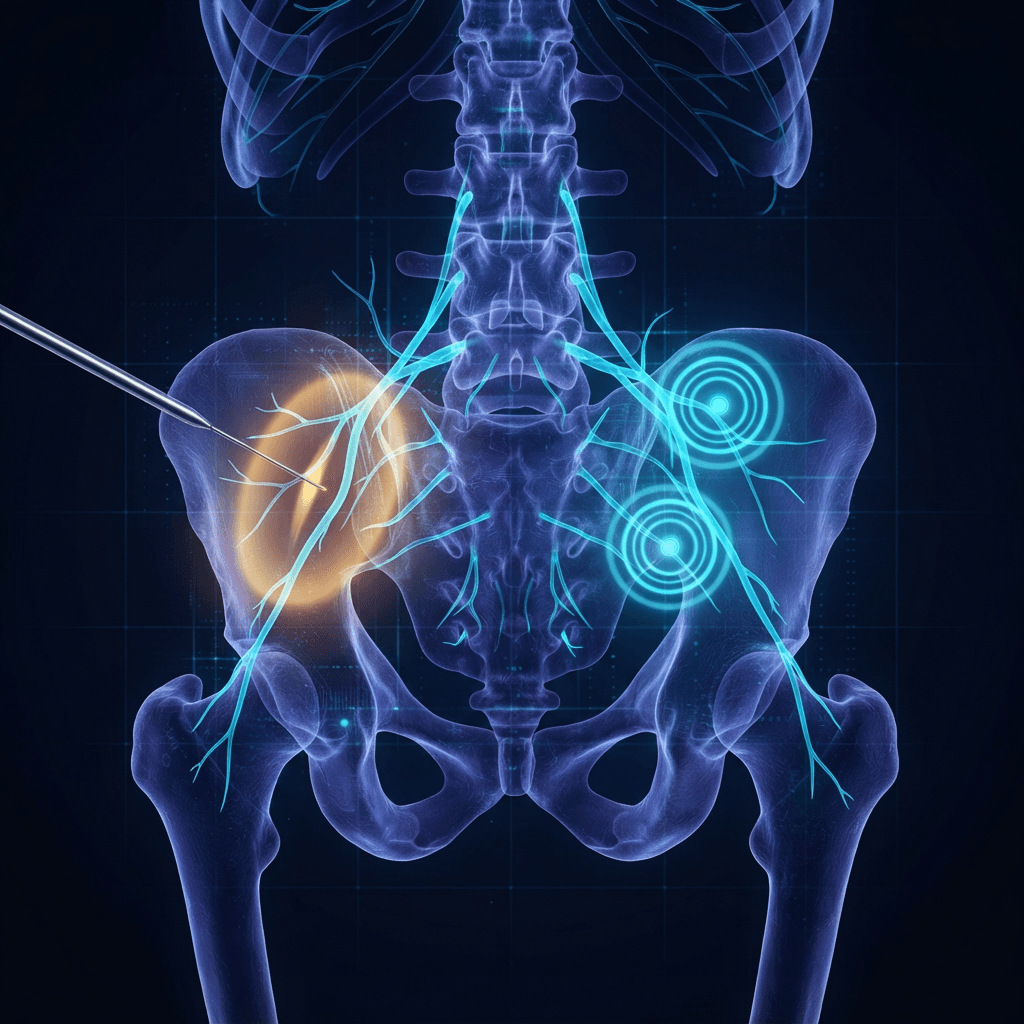
RFA uses heat from radio waves to disable a specific nerve that carries pain signals. A thin, insulated needle is guided to the target nerve with fluoroscopy or ultrasound. It is an outpatient, needle-based procedure with no incision, and it is not surgery.
For the SI joint, RFA targets the small lateral branch nerves that supply the joint. These nerves carry only sensation from the joint, so muscle strength is not meant to change. Cooled and multi-lesion techniques are often used for the SI joint because its nerve supply is variable.
Before RFA, a diagnostic nerve block is usually needed. A local anesthetic is placed next to the nerves RFA would treat; meaningful pain reduction suggests those nerves carry the pain. For SI joint RFA, two positive lateral branch blocks are typically required.
RFA Basics
What to expect from the procedure and recovery.
RFA Advantages
- Longer-lasting relief, often 6 to 18 months for the SI joint
- No incision and no stitches; it is not surgery
- Same-day discharge
- Can be repeated when the nerve regrows
- Targets the pain-carrying nerve, not muscle strength
- Can reduce reliance on repeated injections
RFA Disadvantages
- Needs one or two diagnostic blocks first, so it takes more steps
- Not permanent, because nerves can regrow
- Does not repair the joint; rehabilitation still matters
- A temporary pain flare or burning feeling is common before relief builds
- Uncommon risks include infection, bleeding, nerve irritation, and skin burn
- Insurance coverage for SI joint RFA varies by payer and may need prior authorization
- Guideline panels disagree on how strong the evidence is for joint RFA
How the Two Fit Together
SI joint care often follows a stepwise path. The injection and RFA are two steps along it, supported by rehabilitation.
Prolotherapy and PRP are also available for patients with SI joint ligament laxity or hypermobility. They aim to strengthen the joint rather than suppress inflammation.

Evaluation
Your doctor reviews your pain pattern, exam findings, imaging, and history.
Diagnostic and therapeutic injection
An SI joint injection tests whether the joint is the source and may relieve inflammation.
Lateral branch blocks
If pain returns and longer relief is the goal, blocks on the joint’s nerves confirm the target.
Radiofrequency ablation
After confirmed positive blocks, RFA may offer longer-term relief.
Rehabilitation
Strengthening, movement, weight management, and activity pacing support the result.
How to Think About Your Options
Only a physician can decide which treatment fits after examining you. These patterns can help you prepare for the conversation.
An SI joint injection may be a good place to start if:
- There is not yet a clear answer about whether the SI joint is causing your pain
- There are signs of active inflammation, such as sacroiliitis
- Pain began after pregnancy or after a spinal fusion
- You want a shorter, simpler first step
RFA may be worth discussing if:
- Injections helped but the relief did not last long enough
- Diagnostic blocks of the joint’s nerves gave meaningful, repeatable relief
- Pain has lasted at least three months and conservative care such as physical therapy has been tried
- You are looking for longer relief without surgery
Cautions: RFA may not be appropriate with an active infection, a bleeding disorder or blood thinners that cannot be paused, or pain mainly caused by a pinched nerve root, a fracture, or an unstable spine. Tell your physician about pacemakers, stimulators, or other implanted devices, and about pregnancy.
Your Consultation
Questions to Ask
- Which structure do you think is causing my pain, and how will we confirm it?
- What relief should I expect, and for how long?
- What are the risks for my situation?
- What happens if it does not help?
- How many procedures do you expect I will need over time?
- Will my insurance cover it, and is prior authorization needed?
After Either Procedure
When to Seek Urgent Care
Call the clinic right away if you notice:
- Fever, chills, redness, warmth, swelling, or drainage at the needle site
- New leg weakness or numbness in the groin or saddle area
- Loss of bladder or bowel control
- Severe, worsening pain
Call 911 for chest pain, trouble breathing, or signs of an allergic reaction.
Find Out Which Option Fits Your Pain
Our board-certified pain management specialists will review your pain, imaging, and history to help determine whether an SI joint injection, RFA, or another approach is right for you.
9701 66th Ave, Rego Park, NY 11374
queenspainclinic.com/contact
Medical disclaimer: For education only. Not medical advice. This article is for educational purposes only and does not constitute medical advice; individual results vary. SI joint injections and radiofrequency ablation are medical procedures that require evaluation by a licensed physician. Consult a qualified pain management specialist before making treatment decisions.