Hip Pain Treatment
in Queens, NY
Board-certified interventional pain specialists in Rego Park offer image-guided injections, PRP and rehabilitation for hip pain, with a referral to an orthopedic surgeon when that's the better path.
Hip pain usually comes from the joint, the tendons and bursae on the outside of the hip, an irritated nerve, or the lower back. About 1 in 7 U.S. adults over 60 report significant hip pain on most days.
Queens Pain Clinic works out which source is behind your pain, then builds individualized non-surgical care around it. For some people, surgery is still the better next step.
Last reviewed October 2026
Hip pain usually comes from one of four places: the hip joint itself, the tendons and bursae on the outside of the hip, an irritated nerve, or the lower back. Treatment depends on which it is, so we start by finding out. At Queens Pain Clinic in Rego Park, our board-certified interventional pain specialists use image-guided injections, PRP and targeted rehabilitation to treat hip pain without surgery whenever that is a reasonable option. Some people are better served by an orthopedic surgeon, and if you are one of them we will say so and refer you. Same-day evaluations are subject to schedule availability.
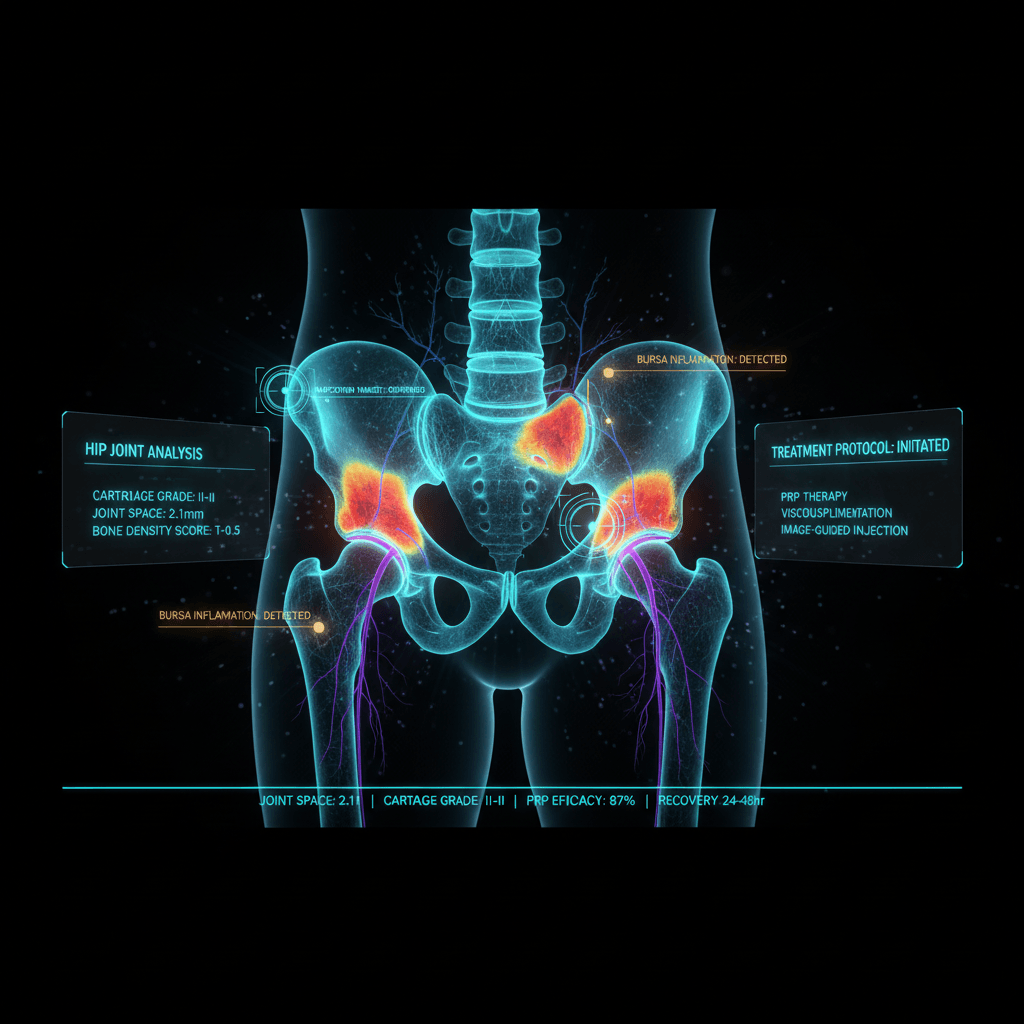
Hip pain from the joint, outer-hip tendons, nerves or the lower back, treated without surgery whenever reasonable
About 1 in 7 U.S. adults over 60 report significant hip pain on most days (NHANES III)
9701 66th Ave, Rego Park, NY 11374
Mon, Tue, Thu, Fri 9 am to 6 pm. Sun 9 am to 3 pm. Closed Wed and Sat
Call 1-877-97 NO PAIN. Same-day evaluations depend on availability
Four Places It Usually Comes From
Hip pain usually comes from one of four places: the hip joint itself, the tendons and bursae on the outside of the hip, an irritated nerve, or the lower back. Treatment depends on which it is, so we start by finding out.
At Queens Pain Clinic in Rego Park, our board-certified interventional pain specialists use image-guided injections, PRP and targeted rehabilitation to offer individualized non-surgical hip pain treatment in Queens.
For some people, surgery is still the better next step. If that's you, we'll say so and refer you to an orthopedic surgeon.
What Causes Hip Pain?
Where it hurts helps point to what's going on. Here's how the common causes line up by location. Hip and spine problems can also exist together.
Hip joint (groin or front of the hip)
Often felt in the groin or front of the hip, sometimes into the knee, with stiffness or catching.
- Hip osteoarthritis
- Labral tear
- Femoroacetabular impingement (FAI)
- Avascular necrosis
Outer-hip tendons and bursae
Felt on the outside of the hip, often worse lying on that side or on stairs.
- Greater trochanteric pain syndrome (GTPS)
- Gluteal tendinopathy
- Iliopsoas tendinopathy
- IT band syndrome
Nerves (buttock, thigh)
Burning or numbness in the buttock, or the outer or inner thigh.
- Piriformis syndrome
- Meralgia paresthetica
- Obturator nerve entrapment
- Sciatic nerve irritation
Lower back and pelvis (referred pain)
Felt in the buttock or upper thigh, and sometimes below the knee.
- L3–L4 disc herniation
- Lumbar facet pain
- Sacroiliac dysfunction
- Lumbar radiculopathy
Pain that seems to come from the back is covered on our low back pain page, and pain that travels to the knee on our knee pain page.
Non-Surgical Hip Pain Treatment Options
Treatment follows the diagnosis. Here's what we may use, and what the research does and doesn't show for each.
Image-guided hip joint injections
A corticosteroid or hyaluronic-acid injection for arthritis pain. Ultrasound or fluoroscopy (live X-ray) guides the needle into the deep joint. Steroid benefit may last weeks to months and varies from person to person. The evidence for hyaluronic acid in hip arthritis is thinner than it is for the knee.
Platelet-rich plasma (PRP)
We draw a small blood sample, concentrate your platelets and inject them into the joint or around a tendon. Trials are mixed: one 111-patient study favored PRP on pain scores at follow-up, while a later 80-patient study found no significant advantage over hyaluronic acid in moderate arthritis. Earlier-stage disease may respond better. PRP may reduce pain and improve function, but it has not been shown to regrow cartilage. Protocols vary, results are not uniform, and studies are small.
Outer-hip injections (GTPS)
Greater trochanteric pain syndrome, often called trochanteric bursitis, causes outer-hip pain that is often worse lying on that side. Steroid injections can give short-term relief. In one primary-care trial, 55% had recovered at three months versus 34% with usual care, but the difference closed by 12 months. We pair injections with strengthening, and may consider PRP for tendon pain that persists.
Piriformis injections
Considered only when the piriformis fits after we have evaluated your lower back. The piriformis lies beside the sciatic nerve, and irritation can cause buttock and leg symptoms that resemble a disc problem. An ultrasound-guided injection may go along with stretching and strengthening. Support for it is mostly small studies and case reports, and the diagnosis itself is debated.
Targeted physical therapy
Strengthening for the hip abductors and external rotators, retraining for walking and stairs, and fixing movement habits that overload a joint or tendon. We coordinate it with injections so you build strength while pain is reduced.
Dextrose prolotherapy
A sugar-solution injection near a ligament or tendon to prompt a healing response. We use it selectively, for loose hip-area ligaments or persistent tendon pain such as iliopsoas tendinopathy. The evidence is limited, and we will tell you so.
Our care emphasizes targeted procedures and rehabilitation rather than long-term opioid prescriptions. We also see auto injury and worker's comp patients.
What Happens at Your Visit
More detail on our first visit page. Questions about coverage or cost? See Insurance and Payment Options.
History and exam
We take your history and examine your hip, back and gait.
Imaging review
We review your X-ray or MRI and arrange imaging if needed, then match the scans to your symptoms.
Plain explanation
We explain the diagnosis and what each treatment can realistically do.
Image-guided treatment
If a procedure fits, it is done under ultrasound or fluoroscopy.
Start rehabilitation
Rehab begins with, or soon after, the injection.
Follow-up
We check your progress, and refer you to orthopedics if you are not improving or surgery is indicated.
- You can’t put weight on your leg after a fall or injury
- Your hip looks deformed
- You have a fever along with a hot, swollen joint
- You have new numbness in the groin or inner thigh
- You lose control of your bladder or bowels
- Your leg suddenly becomes weak
These can point to a fracture, infection or nerve compression.
Hip Pain Questions
Hip Pain Treatment in Queens? Book a Same-Day Evaluation.
We see patients from Rego Park, Forest Hills, Kew Gardens, Elmhurst and Middle Village. Same-day evaluations depend on availability, so call early in the day. Call 1-877-97 NO PAIN or request an appointment online.
9701 66th Ave, Rego Park, NY 11374
Phone: 1-877-97 NO PAIN
- Monday9:00 am to 6:00 pm
- Tuesday9:00 am to 6:00 pm
- WednesdayClosed
- Thursday9:00 am to 6:00 pm
- Friday9:00 am to 6:00 pm
- SaturdayClosed
- Sunday9:00 am to 3:00 pm
- Christmas C, et al. Hip pain in older adults and NHANES III prevalence data.
- Doria C, et al. PRP versus hyaluronic acid in early hip osteoarthritis. Am J Sports Med, 2016.
- Randomized phase III trial of PRP versus hyaluronic acid in hip coxarthrosis.
- Brinks A, et al. Corticosteroid injection for greater trochanteric pain syndrome in primary care: a randomized trial.
- Systematic review and 2022 meta-analysis of corticosteroid injection for greater trochanteric pain syndrome.
- Santamato A, et al. Ultrasound-guided injection for piriformis syndrome: case report and review.
Last reviewed October 2026. This page is for general education and isn't a substitute for an individual medical evaluation.