Prolotherapy: Regenerative Injection
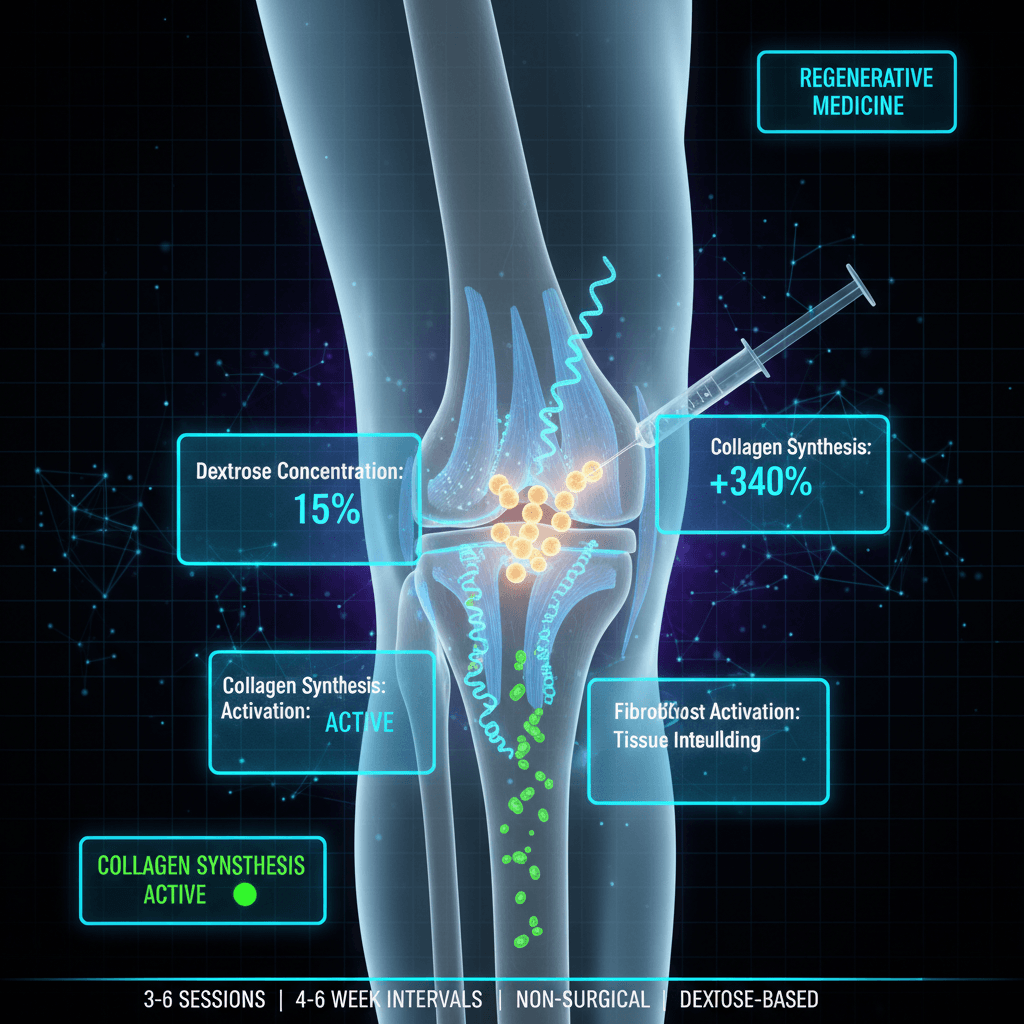
Prolotherapy injects a proliferant solution, most often dextrose, into damaged or lax ligaments, tendons and joint capsules. The controlled irritation triggers the body's healing response, stimulating collagen production to restore structural support and reduce chronic pain.
Key Facts at a Glance
- Targets ligaments, tendons, and joint capsules — not nerves or discs.
- Works by stimulating the body's own healing response rather than suppressing inflammation.
- Typically requires 3 to 6 sessions spaced 4 to 6 weeks apart for full benefit.
- Temporary post-injection soreness is expected and indicates the healing response is active.
Quick Facts
| Question | Short Answer |
|---|---|
| What is injected | A proliferant solution, most commonly dextrose (sugar water) at 10–25% concentration |
| Target location | Ligaments, tendons, and joint capsules at their attachment points (entheses) |
| Guidance | Ultrasound or fluoroscopy for precise placement; some injections done by palpation |
| Duration of procedure | Approximately 15 to 45 minutes depending on the number of sites treated |
| Anesthesia | Local anesthetic mixed into the solution; topical numbing optional |
| Recovery | Temporary soreness for 2–5 days after each session is expected and normal |
| Treatment course | Typically 3 to 6 sessions spaced 4 to 6 weeks apart |
| Pain relief onset | Gradual improvement over weeks to months as tissue remodeling occurs |
| Best for | Chronic ligament laxity, tendinopathy, joint instability, osteoarthritis, low back pain |
| Mechanism | Controlled irritation triggers the body's natural healing cascade to strengthen connective tissue |
Prolotherapy Solution Types
The proliferant solution used in prolotherapy varies based on the severity of the injury, the tissue being treated, and the physician's clinical judgment. Dextrose is the most widely studied and commonly used agent, while PRP and whole blood are used for more complex or severe presentations.
| Solution | Description | Typically Used For | Notes |
|---|---|---|---|
| Dextrose (Hyperosmolar) | Most widely used proliferant; sugar solution at 10–25% concentration | Ligament laxity, tendinopathy, osteoarthritis, spinal instability | Best evidence base; considered the standard prolotherapy solution |
| Platelet-Rich Plasma (PRP) | Patient's own concentrated platelets containing growth factors | Moderate-to-severe tendon tears, partial ligament ruptures, joint degeneration | Higher concentration of growth factors than dextrose; often used for more severe injuries |
| Whole Blood | Autologous whole blood injected at the injury site | Tendinopathy, particularly lateral epicondylitis (tennis elbow) | Simpler preparation than PRP; used when PRP processing is not available |
Conditions Treated
Chronic Low Back Pain
Ligamentous laxity and sacroiliac instability contributing to persistent axial pain
Evidence: Moderate — multiple RCTs show benefit for ligament-mediated low back pain
Knee Osteoarthritis
Cartilage degeneration with associated ligament laxity and joint instability
Evidence: Moderate-to-strong — dextrose prolotherapy shows consistent benefit in trials
Tendinopathy
Chronic tendon degeneration including Achilles, patellar, and rotator cuff tendons
Evidence: Moderate — well-studied for lateral epicondylitis and Achilles tendinopathy
Sacroiliac Joint Dysfunction
Instability and pain at the sacroiliac joint from ligament laxity
Evidence: Moderate — prolotherapy is a recognized treatment for SI joint ligament laxity

Terms Patients Search For
Regenerative injection therapy (RIT), sclerotherapy
Alternative names used for prolotherapy in older literature and some clinical settings.
Enthesis
The attachment point where a tendon or ligament meets bone — the primary target of prolotherapy injections.
PRP (Platelet-Rich Plasma)
A related regenerative injection using concentrated platelets from the patient's own blood — sometimes classified as a form of prolotherapy.
Benefits of Prolotherapy
Prolotherapy aims to strengthen weakened connective tissue instead of only masking pain, using a simple, well-tolerated solution.
Prolotherapy is a regenerative option for chronic ligament, tendon and joint pain. It usually takes a series of treatments, and evidence is stronger for some conditions than others.
- Works gradually over a series of sessions
- Evidence varies by condition
- Generally well tolerated, with temporary soreness common
- Needs individual evaluation by a physician
Medical Disclaimer
This page is for educational purposes only and does not constitute medical advice. Prolotherapy is a medical procedure that requires individual evaluation by a licensed physician. The information here is based on published clinical evidence and is reviewed periodically. Always consult a qualified pain management specialist before making any treatment decisions.
Ready to Discuss Prolotherapy?
Our board-certified pain management specialists at Queens Pain Clinic will evaluate your ligament and tendon health, imaging, and prior treatments to determine whether prolotherapy is right for you.