Spinal Cord Stimulation in Queens, NY
Spinal cord stimulation (SCS) is an implanted device that sends mild electrical pulses to the spinal cord and changes how pain signals reach the brain. Doctors use it for chronic back, leg and arm pain that hasn't improved with medication, injections or surgery.
You try it first with a temporary trial, so you know whether it helps before anything permanent goes in. At Queens Pain Clinic in Rego Park, our board-certified pain physicians have been treating chronic pain in this community since 2004.
Last reviewed October 2026
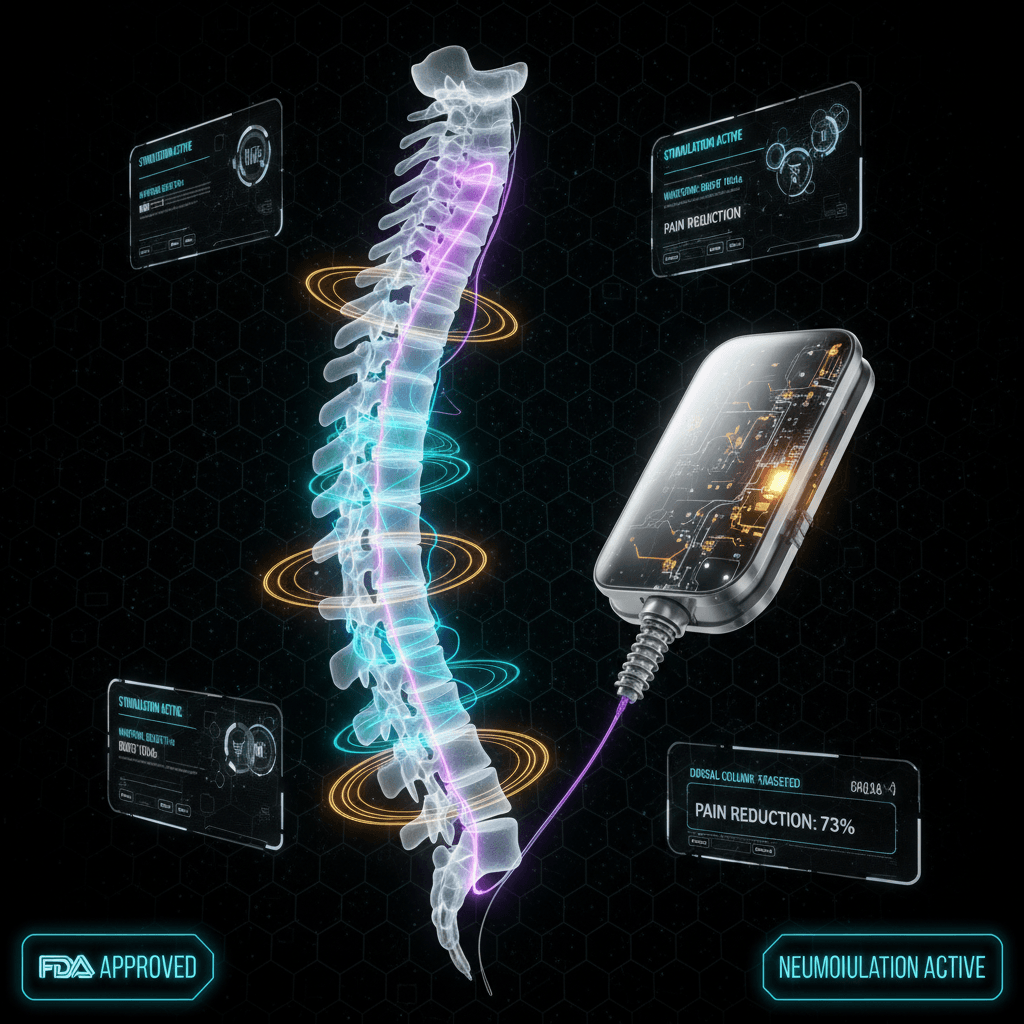
Spinal cord stimulation (SCS) is an implanted device that sends mild electrical pulses to the spinal cord and changes how pain signals reach the brain. Doctors use it for chronic back, leg and arm pain that has not improved with medication, injections or surgery. You try it first with a temporary trial of about a week, so you know whether it helps before anything permanent goes in. It does not fix whatever started the pain. It turns the volume down, and for the right patient that can make a real difference in daily life. The system can be turned off, reprogrammed or removed.
Key Features
Conditions Addressed
Top Benefits
A small implanted pulse generator and thin wires (leads) that stimulate the spinal cord
Chronic back, leg and arm pain, including pain after spine surgery, CRPS and diabetic nerve pain in the legs
Yes. A temporary trial of about a week comes before any permanent implant
Usually at least 50% less pain, plus better sleep, walking or activity
No open spine surgery. An outpatient procedure of roughly one to two hours
Yes. The system can be turned off, reprogrammed or removed
9701 66th Ave, Rego Park, NY 11374
1-877-97 NO PAIN
What Is Spinal Cord Stimulation, and How Does It Work?
The leads send gentle pulses to the dorsal columns, the bundles of nerve fibers that carry sensation up the spinal cord. Those pulses change the pain signals on their way to the brain. Older settings replace the pain with a mild tingling. Newer ones, like burst and high-frequency stimulation, can work without any tingling at all.
It doesn't fix whatever started the pain. What it does is turn the volume down, and for the right patient that can be the difference between a day spent on the couch and a day spent doing things.
At Queens Pain Clinic in Rego Park, SCS is one of the options we offer when simpler treatments haven't done enough. This page covers how it works, who it helps, what the trial and the implant involve, and the risks, so you can decide whether it's worth a conversation.
Thin leads
One or two leads sit in the epidural space, just outside the spinal cord's protective covering.
Pulse generator
A small battery-powered generator is placed under the skin.
Remote or phone app
You use it to adjust the stimulation day to day.
Who Is Spinal Cord Stimulation For?
Most people we consider for SCS have had pain for six months or longer and have already tried the usual steps: medication, physical therapy and often epidural injections, radiofrequency ablation or peripheral nerve stimulation.
- Persistent pain after back or neck surgery (failed back surgery syndrome, post-laminectomy pain)
- Complex regional pain syndrome (CRPS) — see our sympathetic pain page
- Nerve-root pain that travels into an arm or leg (radiculopathy), including pain from a herniated disc
- Painful diabetic neuropathy in the feet and legs
- Chronic low back pain in people who have not had surgery, with some devices
- Arachnoiditis and other long-standing nerve pain
FDA approval is granted device by device, so which of these a specific system is cleared for depends on the model. We'll tell you where the system we recommend stands.
- An active infection
- A spinal problem that needs surgery first
- A medical condition that makes the procedure unsafe, such as blood thinners that cannot be paused
We'll also talk through mood, sleep and other factors that affect how well people do. Many insurers require a short psychological screening before approval.
Relevant condition pages: Low Back Pain, Neck Pain and Sympathetic Pain.
How Does the SCS Process Work, Step by Step?
Five steps, from evaluation to a device programmed for your pain pattern.
Evaluation
We review your history, imaging and past treatments, examine you, and ask what you most want back: walking, sleep, work, time with family. If SCS looks reasonable, we explain the trial.
Trial
In a short procedure, usually with local anesthetic and light sedation, we place temporary leads through a needle into the epidural space. They connect to a small external generator you wear on a belt. You go home and live normally for about a week while you track your pain, sleep and activity.
Review
At your follow-up we compare how you feel to your baseline. A drop of at least 50% is the usual benchmark for moving forward. If the trial did not help, the leads come out and nothing permanent was done. In one 2025 series of 505 trials, about 86% met the benchmark and 77% went on to a permanent implant.
Permanent implant
If you decide to go ahead, we place the permanent leads and tuck the pulse generator under the skin, typically over the upper buttock or along the side of the abdomen. It is an outpatient procedure of about one to two hours, and most people go home the same day.
Recovery and programming
Expect a few weeks of limits on lifting, bending and twisting while the leads settle. We program the device to your pain pattern and fine-tune it at follow-up visits. You can adjust it day to day from the remote or app.
Which Stimulation Types Are Available?
Most current systems can run several kinds of stimulation, and during the trial we can test more than one to see what suits you. What's available depends on the manufacturer and model.
| Type | What you feel | Worth knowing |
|---|---|---|
| Tonic (traditional) | Mild tingling over the painful area | The longest track record |
| Burst | Little or no tingling | Delivers pulses in short bursts instead of a steady stream |
| High-frequency (10 kHz) | No tingling | Often chosen for back and leg pain |
| Closed-loop | Varies | Measures the spinal cord's response and adjusts the output on its own |
How Well Does It Work, and What Are the Risks?
It works well for some people and not at all for others, which is the reason for the trial.
In the PROCESS trial, which compared SCS with conventional medical care for leg pain after back surgery, about 48% of patients with a stimulator had at least 50% leg pain relief at six months, versus roughly 9% of those on conventional care alone. Newer waveforms and better patient selection have improved results in later studies.
In one 2025 series of 505 trials, about 86% met the 50% benchmark and 77% went on to a permanent implant.
Some patients get used to the stimulation over time, and a few need reprogramming or a different waveform to recover it. Most stimulators are meant to be a long-term tool, but not every one stays at its first-year level.
We define success broadly. Half the pain gone matters, but so does sleeping through the night, walking farther, or needing less medication. Some patients are able to reduce opioids after an implant, though that's a goal to discuss with your doctor, not a guarantee.
SCS is a real procedure with real, usually manageable, risks:
- Infection at the incision or around the device
- A lead that shifts out of position, which may need adjusting
- Soreness at the generator or lead site
- Bleeding or, rarely, nerve injury
- Loss of benefit over time
- Device revision or removal in some cases
- MRI limits that vary by device, so tell any imaging team that you have a stimulator
You'll go through each of these, along with how we reduce them, before you agree to a permanent implant.
Many plans cover it when specific criteria are met. These commonly include chronic pain of six months or more, documented treatments that didn't work, a psychological evaluation and a successful trial. Rules differ by insurer and plan, and most require prior authorization.
We also see patients with Worker's Comp and auto injury claims. Our insurance page lists what we accept, and our team can review your plan with you before you commit to anything.
We're a board-certified interventional pain practice, and we've served Queens since 2004. Because we also offer epidural and facet injections, radiofrequency ablation, peripheral nerve stimulation and physical therapy, we can recommend a stimulator when it fits and hold off when it doesn't.
Patients come to us from Forest Hills, Elmhurst, Kew Gardens, Middle Village and the rest of central Queens.
Phone: 1-877-97 NO PAIN
These pages may also help.
Spinal Cord Stimulation FAQ
Find Out If Spinal Cord Stimulation Is Right for You
Book an evaluation and we'll review your history and imaging, answer your questions, and tell you honestly whether SCS makes sense for you. If it doesn't, we'll talk about what does. See what to expect on our Your First Visit page, or call 1-877-97 NO PAIN.
9701 66th Ave, Rego Park, NY 11374
Phone: 1-877-97 NO PAIN
Treating pain in Queens since 2004.
- Monday9:00 am to 6:00 pm
- Tuesday9:00 am to 6:00 pm
- WednesdayClosed
- Thursday9:00 am to 6:00 pm
- Friday9:00 am to 6:00 pm
- SaturdayClosed
- Sunday9:00 am to 3:00 pm
Last reviewed October 2026. This page is for general information and isn't medical advice. Results vary. Talk with a qualified physician before starting any treatment.