Acupuncture for Pain Management
Acupuncture places very thin, sterile needles at specific points to ease chronic pain. It is a low-risk, guideline-supported option for back pain, neck pain, knee osteoarthritis and chronic headache. It beats no treatment and, in the best trials, edges out sham needling — though the edge over sham is small.
Acupuncture is a reasonable, low-risk option for several kinds of chronic pain, including low back pain, neck pain, knee osteoarthritis and chronic headache. It works better than no treatment, and in the best trials it also edges out sham needling. The edge over sham is small, and that is worth saying plainly.
The Numbers Behind That
A pooled analysis of 29 high-quality randomized trials covered 17,922 patients. Pain scores were 0.15–0.23 standard deviations lower with real acupuncture than with sham, and 0.42–0.57 lower than with no acupuncture. A later update put the gap at about 0.2 against sham and about 0.5 against no acupuncture — and found the benefit lasted over time.

Medical disclaimer: This page is general education, not personal medical advice. Talk with your doctor about new or worsening pain before starting any new treatment.
The Basics
What acupuncture is
Acupuncture is a family of techniques in which a practitioner places very thin, solid needles at specific points on the body. Some practitioners add gentle heat (moxibustion), manual stimulation, or a small electrical current (electroacupuncture). Treatment sessions usually run 20 to 40 minutes.
Who it tends to suit
- Adults with chronic musculoskeletal pain who want a drug-free option or a supplement to one
- People with persistent headache or migraine looking to cut down on how often attacks come
- People with knee osteoarthritis who want help alongside exercise and weight management
- Anyone who has had limited relief from usual care and is open to a course of several sessions
Where it falls short
- Acupuncture does not repair a damaged joint or shrink a disc herniation
- It does not replace urgent medical care
- Sudden severe pain, pain after a fall, fever with back pain, new weakness or numbness, and loss of bladder or bowel control all need a medical assessment first

How to read the evidence honestly
Trials comparing acupuncture with sham needling show smaller differences than trials comparing it with no treatment. Researchers think that gap reflects more than the needle itself: the attention, expectation and relaxation of a treatment visit all contribute.
For a person in pain, the practical question is whether the whole experience helps — and for many conditions the answer is yes, with realistic expectations.
Mechanisms
How acupuncture may reduce pain
Nobody has a complete explanation yet. The U.S. National Center for Complementary and Integrative Health says plainly that how acupuncture works is not fully understood. Three ideas carry most of the weight in current research.
Nervous System Signaling
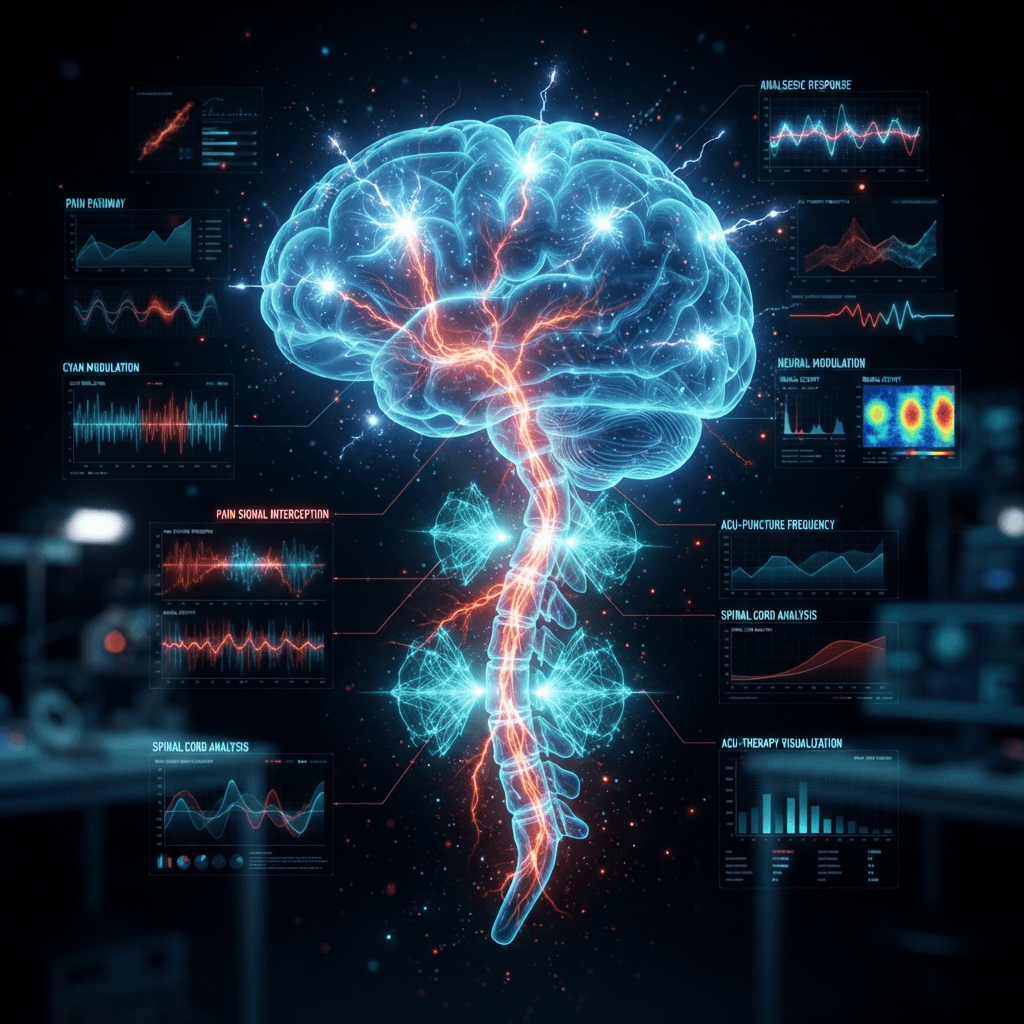
A needle stimulates nerve endings in skin and muscle. Those signals travel to the spinal cord and brain, where they may change how pain messages are processed. Researchers have reported changes in opioid binding and in brain plasticity after acupuncture stimulation, though this work is still developing and does not yet add up to a settled mechanism.
Local Effects in Muscle
Some of the clearest signals come from needling tender muscle knots. In a small set of studies on myofascial pain, needling trigger points reduced pain intensity (5 studies, 215 participants), while needling traditional acupuncture points did not (4 studies, 80 participants). The samples are small, so treat that as a lead, not a verdict.
Context, Attention and Expectation
A treatment visit is calm, unhurried and personal. Pain is shaped by stress, sleep and expectation as well as by tissue, so this part of the experience is not trivial. Researchers who found acupuncture beat sham needling also noted that the margin was modest, which suggests the needling is only one ingredient among several.
Why the sham question matters
Sham acupuncture — such as shallow needling at non-acupuncture points — is hard to make truly inert. That is one reason trial results against sham look smaller than results against no treatment, and one reason the debate about "real" versus "placebo" effects is not likely to end soon. For readers deciding whether to try it, the more useful question is whether a course of treatment helps their pain and function.
Evidence by Condition
Acupuncture by pain condition
Each entry below can stand as its own page on your site. The evidence labels are editorial summaries of the sources listed at the end, not official ratings. Checked October 12, 2026.
Chronic Low Back Pain
Guideline-supported, modest effectThe American College of Physicians lists acupuncture among the non-drug options patients and clinicians should consider first for chronic low back pain, alongside exercise, yoga, tai chi and mindfulness-based stress reduction. It also lists acupuncture for acute and subacute back pain, with the guideline rating that evidence as low quality. In the pooled analysis of high-quality trials, pain was 0.23 standard deviations lower with real acupuncture than with sham for back and neck pain combined. For acute and subacute back pain, the guideline reviewers found a minimal pain benefit over sham and no clear gain in function.
Source: ACP Guideline, 2017
Neck Pain
Moderate evidence for short-term reliefA Cochrane review of 27 studies found that, for mechanical neck pain, acupuncture eased pain in the short term compared with sham or inactive treatment, and also improved neck disability compared with sham. A 2024 meta-analysis of chronic neck pain suggests acupuncture added to other care can give relief lasting at least three months, though it did not beat sham needling. Neck pain after major injury or with arm weakness needs a medical workup first.
Source: Cochrane Review; 2024 Meta-Analysis
Knee Osteoarthritis
Guideline-supported (conditional recommendation)The 2019 American College of Rheumatology and Arthritis Foundation guideline gave acupuncture a conditional recommendation for osteoarthritis, and a 2026 ACR update continues to list it among conditionally recommended options. A 2018 review summarized by NCCIH found acupuncture worked better than no treatment for osteoarthritis pain (10 studies, 2,413 participants) and better than sham (9 studies, 2,376 participants), with the gap over no treatment being the larger one. Acupuncture is best framed as a partner to exercise and weight management, which the guideline recommends strongly.
Source: ACR/Arthritis Foundation Guideline, 2019 & 2026
Migraine and Chronic Headache
Moderate evidenceA Cochrane review on preventing episodic migraine found acupuncture reduced attack frequency more than drug prevention right after treatment (3 trials, 739 participants), though that edge was not significant at follow-up. The reviewers concluded it can be considered a treatment option for patients willing to try it, and noted a lack of studies longer than a year. For chronic headache in the pooled analysis, pain was 0.15 standard deviations lower than with sham and 0.42 lower than with no acupuncture. A new or "worst ever" headache needs urgent medical attention.
Source: Cochrane Review; Vickers et al. Pooled Analysis
Fibromyalgia
Low-quality evidence; reasonable as an add-onResults are mixed. A meta-analysis of 12 trials found acupuncture beat sham for pain and quality of life in the short term, with low-to-moderate quality evidence. A 2025 overview of systematic reviews found no high-quality evidence, and an umbrella review concluded the benefits were small and that more than half of the improvement was not tied to the needling itself. Honest framing here builds trust: acupuncture may help some people as part of a broader plan with exercise, sleep care and medical follow-up.
Source: 2025 Overview of Systematic Reviews
Shoulder Pain
Some supportive evidenceShoulder pain was one of the four conditions in the large pooled analysis, where acupuncture was superior to both sham and no-acupuncture controls across all conditions studied. Condition-specific detail is thinner than for back pain or knee osteoarthritis, so this entry should stay short and point to your own clinical approach and referral criteria.
Source: Vickers et al. Pooled Analysis
Sciatica from a Herniated Disc
Promising, still developingA 2024 randomized trial in China enrolled 216 adults with chronic sciatica from disc herniation. After 10 sessions over four weeks, leg pain on a 0 to 100 scale fell by 31 points with acupuncture versus 15 with sham, and disability scores fell by 13 versus 5 points. Minor bleeding was more common with real acupuncture (24% versus 5%). A 2025 overview of reviews called the wider evidence promising but limited by methodological flaws and poor reporting.
Source: JAMA Internal Medicine Trial, 2024
Cancer-Related Pain
Specialist territoryOncology acupuncture is described in the research literature as its own area of practice, with its own safety and care considerations. If you treat people during cancer care, treatment should be coordinated with the oncology team. Avoid specific outcome claims unless you cite a source for each.
Source: NCI Oncology Material
Guidelines & Research
Guidelines and evidence at a glance
Major guidelines endorse acupuncture as one option for back pain and osteoarthritis, and trial data support it for several chronic pain conditions — but nearly every source describes the evidence as modest or low quality. Use this table as a citation backbone for the condition pages. Checked October 12, 2026.
| Condition | Source | What it says | Strength |
|---|---|---|---|
| Low back pain | ACP guideline, 2017 | Acupuncture is among the initial non-drug options for acute, subacute and chronic low back pain | Low quality |
| Knee osteoarthritis | ACR/Arthritis Foundation, 2019 & 2026 | Conditional recommendation; 2026 update keeps it as a conditional option | Conditional |
| Back, neck, OA, headache | Vickers et al. pooled analysis | Real acupuncture beat sham and no acupuncture in 29 trials, 17,922 patients; sham gap was modest | High-quality trials only |
| Same + shoulder pain | Vickers et al. update | About 0.5 SD better than no acupuncture and about 0.2 SD better than sham, with effects persisting over time | Pooled patient data |
| Episodic migraine | Cochrane review | Reduced attack frequency more than drug prevention after treatment; not significant at follow-up | Moderate |
| Chronic neck pain | Cochrane review | Short-term benefit for pain and disability versus sham, inactive treatment or waiting list | Moderate |
| Fibromyalgia | 2025 overview of reviews | No high-quality evidence found; low-quality evidence of benefit | Low |
| Sciatica from disc herniation | JAMA Internal Medicine, 2024 | Greater pain and disability relief than sham after four weeks | Single large trial |
| Safety | Serious-event review | Serious events are rare, about 0.04 to 0.08 per 10,000 treatments, and mostly preventable | Review of literature |
Two cautions apply across the board. Most trials ran for weeks to a few months, so long-term outcomes are less certain. And the NCCIH summary notes that for several conditions the benefit over sham is small, which is why honest pages say "may help" and not "treats" or "cures."
Treatment
What to expect from treatment and how safe it is
A first visit usually takes longer than later ones, because the practitioner starts with a history: where the pain is, what makes it better or worse, medications, past injuries and sleep. A short physical exam follows, then the needling itself. Most people describe the needles as a dull ache, a warm heaviness or a mild tingle — and many say it is less uncomfortable than they expected.
How many sessions
There is no universal number. The sciatica trial described above used 10 sessions across four weeks. A sensible approach for your own patients is to agree on a course, then review progress at a set point — for example after four to six visits — and stop or change course if nothing has shifted.
Contact our clinic for typical course length, session length, pricing and insurance details.
Side effects and risks
Serving readers well means being specific about harm. Serious problems are rare, and most are preventable.
Tell your practitioner first if you
- Take blood thinners or have a bleeding disorder
- Have a pacemaker or other implanted electrical device, especially if electroacupuncture is planned
- Are pregnant or might be
- Have a weakened immune system or an active skin infection near the treatment area
- Tend to faint during injections or blood draws
When to see a doctor instead
Get medical care first — not acupuncture — for sudden severe pain, pain after significant trauma, back pain with fever, new weakness or numbness, or loss of bladder or bowel control.
- Sudden severe pain
- Pain after significant trauma
- Back pain with fever
- New weakness or numbness
- Loss of bladder or bowel control
- A new or "worst ever" headache
Acupuncture is a complement to medical care, not a stand-in for diagnosis.
Questions & Answers
Frequently asked questions
Each answer opens with a direct statement of one or two sentences so it can be lifted on its own by search snippets and AI answer engines.
Does acupuncture work for chronic pain?
Yes, for several types, with modest effects. A pooled analysis of 29 high-quality trials found real acupuncture reduced chronic back, neck, shoulder, osteoarthritis and headache pain more than both sham needling and no treatment. The advantage over sham was small, and the advantage over no treatment was larger.
Is acupuncture just a placebo?
Not entirely. Real acupuncture outperformed sham acupuncture in the largest pooled analysis, but the difference was modest. That suggests the needling contributes something, and that expectation, attention and relaxation during treatment also play a real part.
How does acupuncture relieve pain?
The exact mechanism is not fully understood. Leading explanations include nerve signals that change how the spinal cord and brain process pain, local effects in tight muscle, and the broader effects of a calm, attentive treatment setting.
Is acupuncture good for lower back pain?
It is a guideline-supported option. The American College of Physicians recommends considering acupuncture, along with other non-drug approaches such as exercise, for chronic low back pain, and lists it for acute and subacute back pain as well. The guideline rates the supporting evidence as low quality.
Can acupuncture help knee osteoarthritis?
It can help some people. The American College of Rheumatology gives acupuncture a conditional recommendation for osteoarthritis. It works best alongside the strongly recommended basics of exercise and, where relevant, weight loss.
Can acupuncture prevent migraines?
It can reduce how often attacks occur. A Cochrane review found acupuncture lowered migraine frequency more than drug prevention immediately after treatment, though the difference was not significant at follow-up. Studies longer than one year are still lacking.
How many acupuncture sessions will I need for pain?
It varies by person and condition. One large sciatica trial used 10 sessions over four weeks. A good practitioner will set a review point early, often after four to six visits, and adjust the plan if you are not improving.
How long do the effects last?
That depends on the condition. The pooled patient-data update found treatment effects persisted over time. For chronic neck pain, a 2024 meta-analysis found relief lasting at least three months when acupuncture was added to other care.
Does acupuncture hurt?
Usually only a little. Acupuncture needles are far thinner than injection needles. Common sensations are a brief pinch, a dull ache or warmth at the point. Bruising or a small spot of bleeding can happen afterward.
Is acupuncture safe?
When a trained practitioner uses single-use sterile needles, serious problems are rare. One review put serious adverse events at roughly 0.04 to 0.08 per 10,000 treatments, with collapsed lung, nerve injury and infection the most likely. Most of those are preventable with proper technique.
Can I use acupuncture with my pain medication?
Often, yes. A 2023 meta-analysis on knee osteoarthritis found that acupuncture added to oral medication improved pain and function more than medication alone in the short term. Tell your prescriber and your acupuncturist about everything you take, including blood thinners.
When should I see a doctor before trying acupuncture?
See a doctor first for sudden severe pain, pain after an injury, back pain with fever, new numbness or weakness, or loss of bladder or bowel control. These can signal conditions that need urgent evaluation.
Definitions
Glossary
Plain-language definitions for key research and treatment terms used throughout this page.
Acupuncture
Placing thin, solid needles at specific points on the body to relieve symptoms.
Sham Acupuncture
A look-alike procedure used as a control in trials, such as shallow needling at non-acupuncture points.
Electroacupuncture
Acupuncture in which a small electrical current passes between pairs of needles.
Moxibustion
Warming an acupuncture point with burning mugwort, usually held near the skin.
Trigger Point
A tender knot in muscle that can refer pain to other areas.
Randomized Controlled Trial
A study that assigns people by chance to a treatment or a comparison group.
Meta-Analysis
A statistical pooling of results from several studies.
Standard Deviation (SD)
A unit for expressing effect size; larger numbers mean bigger differences between groups.
Conditional Recommendation
A guideline term meaning the benefit is likely but evidence or trade-offs leave room for patient preference.
Pneumothorax
A collapsed lung, a rare serious complication of needling too deep near the chest.
References
Sources
Figures in this catalogue come from the abstracts and summaries of the sources below. Open the full text before you publish any number.
- Vickers et al., individual patient data meta-analysis, Archives of Internal Medicine and its update in the Journal of Pain
- NCCIH, Acupuncture: Effectiveness and Safety and Arthritis and Complementary Health Approaches
- American College of Physicians, low back pain guideline and the AAFP summary
- ACR/Arthritis Foundation, 2019 osteoarthritis guideline and a summary of the 2026 update
- Cochrane, acupuncture for prevention of episodic migraine
- Cochrane, acupuncture for neck disorders, and the 2024 meta-analysis on durable effects in chronic neck pain
- Fibromyalgia: 2025 overview of systematic reviews, a 12-trial meta-analysis and an umbrella review
- Sciatica: JAMA Internal Medicine trial summary, Medicine Today digest and a 2025 overview of reviews
- Safety: review of serious adverse events and a systematic review of case reports
- Oncology: NCI conference summary on acupuncture in cancer care
Ready to explore acupuncture for your pain?
Our physicians at Queens Pain Management Clinic can help you decide whether acupuncture fits your situation — and how it might work alongside your existing care.